Advertisements
Advertisements
Question
In which equipment/s do you find ___________________
Advertisements
Solution
(i) Concave mirror is found in torches, headlights, flood lights, solar devices,dentist's mirror.
(ii) Convex lens is used in simple microscope, compound microscope, telescopes, optical instruments and spectacles.
(iii) Reflecting mirrors are used in projector lamps, telescopes.
APPEARS IN
RELATED QUESTIONS
Study the following diagram and select the correct statement about the device 'X' :
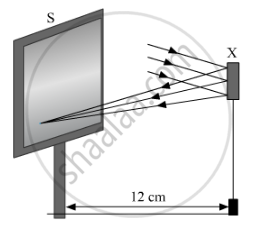
(A) Device 'X' is a concave mirror of radius of curvature 12 cm
(B) Device 'X' is a concave mirror of focal length 6 cm
(C) Device 'X' is a concave mirror of focal length 12 cm
(D) Device 'X' is a convex of mirror of focal length 12 cm
The image formed by a concave mirror is observed to be virtual, erect and larger than the object. Where should the position of the object be relative to the mirror? Draw ray diagram to justify your answer.
A spherical mirror produces an image of magnification -1.0 on a screen placed at a distance of 30 cm from the pole of the mirror.
(i) Write the type of mirror in this case.
(ii) What is the focal length of the mirror ?
(iii) What is the nature of the image formed ?
(iv) Draw the ray diagram to show the image formation in this case.
For what position of an object, a real and diminished image is formed by a concave mirror?
Draw a ray diagram showing how a concave mirror can be used to produce a real, inverted and diminished image of an object.
At what distance from a concave mirror focal length 10 cm should an object 2 cm long be placed in order to get an erect image 6 cm tall?
At what distance from a concave mirror of focal length 10 cm should an object be placed so that:
- its real image is formed 20 cm from the mirror?
- its virtual image is formed 20 cm from the mirror?
Which of the following are concave mirrors and which convex mirrors?
Shaving mirrors, Car headlight mirror, Searchlight mirror, Driving mirror, Dentist’s inspection mirror, Torch mirror, Staircase mirror in a double-decker bus, Make-up mirror, Solar furnace mirror, Satellite TV dish, Shop security mirror.
Draw a ray diagram to show the formation of image of an object placed on the principal axis of a convex mirror. State the position, size and nature of the image. What happens to the image as the object is moved away from the mirror?
A student obtained a sharp image of the grills of a window on a screen using a concave mirror. His teacher remarked that for getting better results a well lit distant object (preferably the sun) should be focussed on the screen. What should be done for this purpose?
(A) Move the screen slightly away from the mirror
(B) Move the mirror slightly towards the screen
(C) Move the screen and the mirror away from the object
(D) Move the screen and the mirror towards the object
Why does obtaining the image of the sun on paper with the help of a concave mirror burn the paper?
Study the following ray diagram and list two mistakes committed by the student while tracing it. Rectify these mistakes by drawing the correct ray diagram to show the real position and size of the image corresponding to the position of the object AB.

Explain the images formed by a concave mirror.
The radius of curvature of a concave mirror whose focal length is 5cm is ______
Under which of the following conditions a concave mirror can form an image larger than the actual object?
Beams of light are incident through the holes A and B and emerge out of box through the holes C and D respectively as shown in the figure. Which of the following could be inside the box?

You are provided with a convex mirror, a concave mirror, a convex lens and a concave lens. You can get an inverted image from
Define principal focus of the concave mirror.
A student wants to obtain an erect image of an object using a concave mirror of 10 cm focal length. What will be the distance of the object from mirror?
