Advertisements
Advertisements
Question
State whether the following statement is True or False.
The sides of an object and its image formed by a concave mirror are always interchanged
Options
True
False
Advertisements
Solution
This statement is True.
Explanation:
In a concave mirror, the image formed is often inverted, meaning that the top and bottom or sides of the object and its image are interchanged. For example, if an object is placed in front of the mirror, its image will appear upside down (inverted) and may be laterally reversed (left to right), depending on the object’s position relative to the focal point. This is one of the typical characteristics of image formation by a concave mirror.
APPEARS IN
RELATED QUESTIONS
A 3 cm tall object is placed 18 cm in front of a concave mirror of focal length 12 cm. At what distance from the mirror should a screen be placed to see a sharp image of the object on the screen. Also calculate the height of the image formed.
For a convex mirror, parallel rays of light appear to diverge from a point called the ______.
Draw the following diagram in your answer book and show the formation of image with the help of suitable rays:
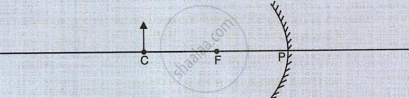
With the help of a labelled ray diagram, describe how a converging mirror can be used to give an enlarged upright image of an object.
Name the lens which can concentrate sun's rays to a point and burn a hole in a piece of paper.
In the following diagram. MM' is a concave mirror and AB is an object. Draw on your answer-sheet a ray diagram to show the formation of image of this object.
Answer the following question:
An object is placed at a distance of 30 cm from a concave lens of focal length 30 cm.
(i) Use the lens formula to determine the distance of the image from the lens.
(ii) List four characteristics of the image (nature, position, size, erect/inverted) in this case.
(iii) Draw a labelled diagram to justify your answer of the part (ii)
Beams of light are incident through the holes A and B and emerge out of box through the holes C and D respectively as shown in the figure. Which of the following could be inside the box?

Rays from Sun converge at a point 15 cm in front of a concave mirror. Where should an object be placed so that size of its image is equal to the size of the object?
