Advertisements
Advertisements
प्रश्न
State whether the following statement is True or False.
The sides of an object and its image formed by a concave mirror are always interchanged
पर्याय
True
False
Advertisements
उत्तर
This statement is True.
Explanation:
In a concave mirror, the image formed is often inverted, meaning that the top and bottom or sides of the object and its image are interchanged. For example, if an object is placed in front of the mirror, its image will appear upside down (inverted) and may be laterally reversed (left to right), depending on the object’s position relative to the focal point. This is one of the typical characteristics of image formation by a concave mirror.
APPEARS IN
संबंधित प्रश्न
Consider the following diagram in which M is a mirror and P is an object and Q is its magnified image formed by the mirror.
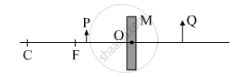
State the type of the mirror M and one characteristic property of the image Q.
Draw the following diagram in your answer book and show the formation of image with the help of suitable rays:

What kind of mirror can have a focal length of, −20 cm?
How far should an object be placed from the pole of a converging mirror of focal length 20cm to form a real image of the size exactly `1/4`th the size of the object?
Why does a beam of light when it enters glass at an angle? Why does it not bend if it inters the glass at right angles?
The mirror used by the ophthalmologist to examine the eye is _______.
Give any two applications of a concave and convex mirror.
State whether true or false. If false, correct the statement.
When an object is at the centre of curvature of concave mirror the image formed will be virtual and erect.
In which of the following, the image of an object placed at infinity will be highly diminished and point sized?
In torches, searchlights, and headlights of vehicles, the bulb is placed ______ of the concave mirror.
