Advertisements
Advertisements
प्रश्न
In which equipment/s do you find ___________________
Advertisements
उत्तर
(i) Concave mirror is found in torches, headlights, flood lights, solar devices,dentist's mirror.
(ii) Convex lens is used in simple microscope, compound microscope, telescopes, optical instruments and spectacles.
(iii) Reflecting mirrors are used in projector lamps, telescopes.
APPEARS IN
संबंधित प्रश्न
Draw a ray diagram for concave mirror when the object is between centre of curvature and focus.
With the help of an appropriate ray diagram, state the sign conventions for reflection by a spherical mirror.
Consider the following diagram in which M is a mirror and P is an object and Q is its magnified image formed by the mirror.
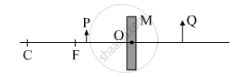
State the type of the mirror M and one characteristic property of the image Q.
To construct ray diagrams, two rays of light are generally so chosen that it is easy to determine their directions after reflection from a mirror. Choose two such rays and state the path/direction of these rays after reflection from a concave mirror. Use these two rays to find the position and nature of the image of an object placed at a distance of 8 cm from a concave mirror of focal length 12 cm.
The angle between an incident ray and the plane mirror is 30°. The total angle between the incident ray and reflected ray will be:
(a) 30°
(b) 60°
(c) 90°
(d) 120°
Copy this figure in your answer book and show the direction of the light ray after reflection:

A concave mirror produces three times enlarged virtual image of an object placed at 10 cm in front of it. Calculate the radius of curvature of the mirror.
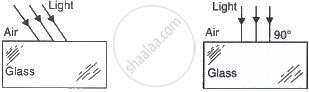
Draw and complete the following diagrams to show what happens to the beams of light as they enter the glass block and then leave it:
Which of the following can make a parallel beam of light from a bulb falls on it?
(a) concave mirror as well as concave lens
(b) convex mirror as well as concave lens
(c) concave mirror as well as convex lens
(d) concave mirror as well as convex lens
A student has to trace the path of a ray of light passing through a rectangular glass slab for four different values of angle of incidence.
(a) Write two important precautions for this experiment.
(b) List two conclusions the student will draw based on his experiment.
Why does obtaining the image of the sun on paper with the help of a concave mirror burn the paper?
Consider the following properties of virtual images:
- cannot be projected on the screen
- are formed by both concave and convex lens
- are always erect
- are always inverted
The correct properties are:
Which of the following mirror is used by a dentist to examine a small cavity in a patient’s teeth?
Under which of the following conditions a concave mirror can form an image larger than the actual object?
You are provided with a concave mirror, a convex mirror, a concave lens and a convex lens. To obtain an enlarged image of an object you can use either
The ENT doctor uses a ______.
______ mirrors make things look larger when objects are placed close to them.
The image formed by a concave mirror is real, inverted and of the same size as that of the object, the position of the object should be ______.
A student took three concave mirrors of different focal lengths and performed the experiment to see the image formation by placing an object at different distance with these mirrors as shown in the following table.
| Case No. | Object-distance | Focal length |
| I | 45 cm | 20 cm |
| II | 30 cm | 15 cm |
| III | 20 cm | 30 cm |
Now answer the following questions:
(a) List two properties of the image formed in Case I.
(b) In which one of the cases given in the table, the mirror will form real image of same size and why?
(c) Name the type of mirror used by dentists. Given reason why do they use such type of mirrors.
OR
(c) Look at the table and identify the situation (object distance and focal length) which resembles the situation in which concave mirrors are used as shaving mirrors? Draw a ray diagram to show the image formation in this case.
