Advertisements
Advertisements
प्रश्न
Which type of mirror is used in the following?
Head lamps of a car
Advertisements
उत्तर
Concave mirror
APPEARS IN
संबंधित प्रश्न
A student has obtained the image of a distant object with a concave mirror to determine its focal length. If he has selected a well-illuminated red building as object, which of the following correctly describes the features of the image formed?
(A) Virtual, inverted and diminished image in red shade
(B) Real, erect and diminished image in pink shade
(C) Real, inverted and diminished image in red shade
(D) Virtual, erect and enlarged image in red shade
The image formed by a concave mirror is observed to be virtual, erect and larger than the object. Where should be the position of the object?
Fill in the following blank with suitable word:
Parallel rays of light are reflected by a concave mirror to a point called the ..........
A concave mirror ______ rays of light whereas a convex mirror ______ rays of light.
Draw diagram to represent the action of a concave mirror on a beam of parallel light rays. Mark on this diagram principal axis, focus F, centre of curvature C, pole P and focal length f, of the concave mirror.
Draw the following diagram in your answer book and show the formation of image of the object AB with the help of suitable rays:
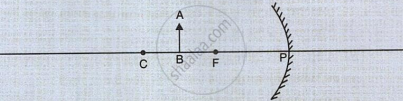
Explain why, a ray of light passing through the centre of curvature of a concave mirror gets reflected back along the same path.
What kind of mirror can have a focal length of, −20 cm?
An object is placed at a distance of 10 cm from a concave mirror of focal length 20 cm.
- Draw a ray diagram for the formation of image.
- Calculate the image distance.
- State two characteristics of the image formed.
Between which two points of concave mirror should an object be placed to obtain a magnification of:
(a) −3
(b) +25
(c) −0.4
A real image of an object is to be obtained. The mirror required for this purpose is:
(a) convex
(b) concave
(c) plane
(d) either convex or concave
Why does a beam of light when it enters glass at an angle? Why does it not bend if it inters the glass at right angles?
Draw a ray diagram to show the formation of the image of an object placed beyond the centre of curvature of a concave mirror. State the position, size and nature of the image.
Match the following.
| Convex mirror | Radio telescopes |
| Parobolic mirror | Rear – view mirror |
| Snell’s law | Kaleidoscope |
| Dispersion of light | sin i/sin r =μ |
| Refractive index | Rainbow |
According to cartesion sign convention, which mirror and which lens has negative focal length?
Name the mirror(s) that can give (i) an erect and enlarged image, (ii) same sized, inverted image
Beams of light are incident through the holes A and B and emerge out of box through the holes C and D respectively as shown in the figure. Which of the following could be inside the box?

Rays from Sun converge at a point 15 cm in front of a concave mirror. Where should an object be placed so that size of its image is equal to the size of the object?
______ mirrors magnify the object placed close to them.
