Advertisements
Advertisements
Question
Why are concave mirrors used in solar devices?
Advertisements
Solution
A concave mirror is also known as a converging mirror because of its ability to focus parallel rays of light at a single point on its focal plane. This property is used in solar devices. Parallel rays from the Sun, when reflected by the concave mirror, are focused at a particular point, generating a significant amount of heat. This heat is essential for the proper functioning of solar devices, such as solar cookers or solar furnaces.
APPEARS IN
RELATED QUESTIONS
Draw a ray diagram to show the path of the refracted ray in each of the following cases:-
A ray of light incident on a concave lens is
(i) passing through its optical centre.
(ii) parallel to its principal axis.
(iii) directed towards its principal focus.
Draw the following diagram in which a ray of light is incident on a concave/convex mirror on your answer sheet. Show the path of this ray, after reflection, in each case.

A 3 cm tall object is placed 18 cm in front of a concave mirror of focal length 12 cm. At what distance from the mirror should a screen be placed to see a sharp image of the object on the screen. Also calculate the height of the image formed.
An object is placed at a distance of 12 cm in front of a concave mirror of radius of curvature 30 cm. List four characteristics of the image formed by the mirror.
An object is placed at the following distances from a concave mirror of focal length 15 cm, turn by turn:
(a) 35 cm
(b) 30 cm
(c) 20 cm
(d) 10 cm
Which position of the object will produce:
(i) a magnified real image?
(ii) a magnified virtual image?
(iii) a diminished real image?
(iv) an image of same size as the object?
What is the position of the image when an object is placed at a distance of 20 cm from a concave mirror of focal length 20 cm?
If an object of 10 cm height is placed at a distance of 36 cm from a concave mirror of focal length 12 cm, find the position, nature and height of the image.
At what distance from a concave mirror focal length 10 cm should an object 2 cm long be placed in order to get an erect image 6 cm tall?
A bright object 50 mm high stands on the axis of a concave mirror of focal length 100 mm and at a distance of 300 mm from the concave mirror. How big will the image be?
How far should an object be placed from the pole of a converging mirror of focal length 20cm to form a real image of the size exactly `1/4`th the size of the object?
An object is placed at a large distance in front of a concave mirror of radius of curvature 40 cm. The image will be formed in front of the mirror at a distance:
(a) 20 cm
(b) 30 cm
(c) 40 cm
(d) 50 cm
Between which two points of concave mirror should an object be placed to obtain a magnification of:
(a) −3
(b) +25
(c) −0.4
The mirror used by a dentist to examine the teeth of a person is ______.
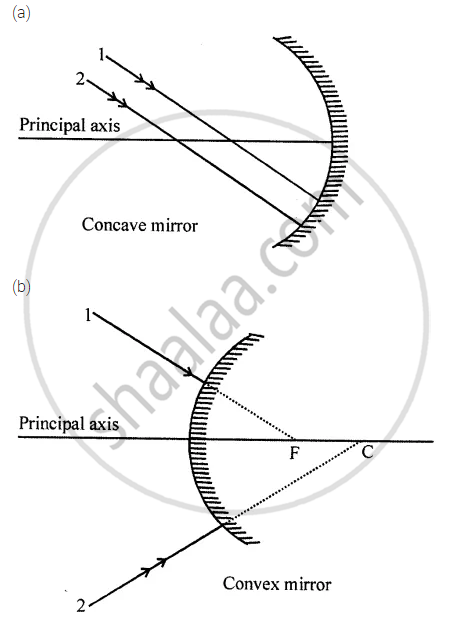
Complete the following diagrams in figure by drawing the reflected rays for the incident rays 1 and 2 if F is the focus and C is the centre of curvature.
A student has to trace the path of a ray of light passing through a rectangular glass slab for four different values of angle of incidence.
(a) Write two important precautions for this experiment.
(b) List two conclusions the student will draw based on his experiment.
List four characteristics of the image formed by a concave mirror of focal length 40 cm when the object is placed in front of it at a distance of 20 cm from its pole.
An object at a distance of 30 cm from a
concave mirror gets its image at the same point. The focal length of the mirror is ______.
In torches, searchlights, and headlights of vehicles, the bulb is placed ______ of the concave mirror.
