Advertisements
Advertisements
Question
Which type of mirror is used in the following?
Shaving mirror
Advertisements
Solution
Concave mirror
APPEARS IN
RELATED QUESTIONS
"A concave mirror of focal length 15 cm can form a magnified, erect as well as inverted image of an object placed in front of it." Justify this statement stating the position of the object with respect to the pole of the mirror in both the cases for obtaining the images.
Draw ray diagrams to show the principal focus of a convex mirror.
To construct ray diagrams, two rays of light are generally so chosen that it is easy to determine their directions after reflection from a mirror. Choose two such rays and state the path/direction of these rays after reflection from a concave mirror. Use these two rays to find the position and nature of the image of an object placed at a distance of 8 cm from a concave mirror of focal length 12 cm.
A spherical mirror produces an image of magnification −1 on a screen placed at a distance of 40 cm from the mirror:
(i) Write the type of mirror.
(ii) What is the nature of the image formed?
(iii) How far is the object located from the mirror?
(iv) Draw the ray diagram to show the image formation in this case.
Three students A, B and C focussed a distant building on a screen with the help of a concave mirror. To determine focal length of the concave mirror they measured the distances as given below:
Student A : From mirror to the screen
Student B : From building to the screen
Student C : From building to the mirror
Who measured the focal length correctly ;
(a) Only A
(b) Only B
(c) A and B
(d) B and C
The image of a candle flame placed at a distance of 30 cm from a mirror is formed on a screen placed in front of the mirror at a distance of 60 cm from its pole. What is the nature of the mirror? Find its focal length. If the height of the flame is 2.4 cm, find the height of its image. State whether the image formed is erect or inverted.
Draw the following diagram in your answer book and show the formation of image with the help of suitable rays:

With the help of a ray diagram, determine the position, nature and size of the image formed of an object placed at the centre of curvature of a concave mirror.
Make labelled ray diagrams to illustrate the formation of:
a virtual image by a converging mirror.
Mark clearly the pole, focus, centre of curvature and position of object in each case.
The real image formed by a concave mirror is larger than the object when object is:
(a) at a distance equal to radius of curvature
(b) at a distance less than the focal length
(c) between focus and centre of curvature
(d) at a distance greater than radius of curvature
A converging mirror forms a real image of height 4 cm of an object of height 1 cm placed 20 cm away from the mirror:
- Calculate the image distance.
- What is the focal length of the mirror?
A concave mirror has a focal length of 4 cm and an object 2 cm tall is placed 9 cm away from it. Find the nature, position and size of the image formed.
An object is 24 cm away from a concave mirror and its image is 16 cm from the mirror. Find the focal length and radius of curvature of the mirror, and the magnification of the image.
At what distance from a concave mirror of focal length 10 cm should an object be placed so that:
its real image is formed 20 cm from the mirror?
If the image formed is always virtual, the mirror can be:
(a) concave or convex
(b) concave or plane
(c) convex or plane
(d) only convex
A real image of an object is to be obtained. The mirror required for this purpose is:
(a) convex
(b) concave
(c) plane
(d) either convex or concave
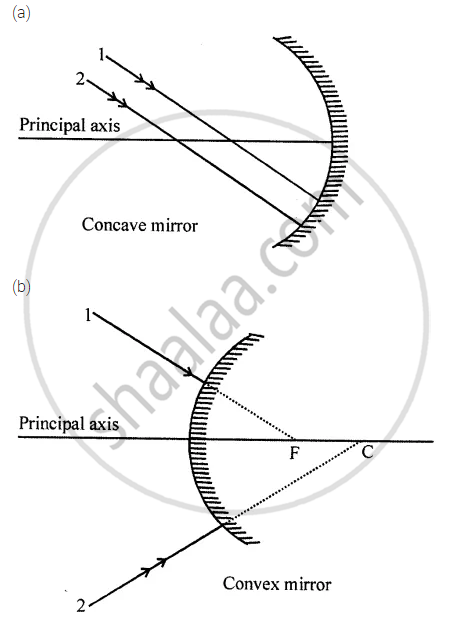
Complete the following diagrams in figure by drawing the reflected rays for the incident rays 1 and 2 if F is the focus and C is the centre of curvature.
Why are concave mirrors used in solar devices?
In which equipment/s do you find ___________________
In the headlights of motor vehicles, ______ mirrors are used as reflectors.
