Advertisements
Advertisements
प्रश्न
Which type of mirror is used in the following?
Shaving mirror
Advertisements
उत्तर
Concave mirror
APPEARS IN
संबंधित प्रश्न
State two positions in which a concave mirror produces a magnified image of a given object. List two differences between the two images.
Consider the following diagram in which M is a mirror and P is an object and Q is its magnified image formed by the mirror.
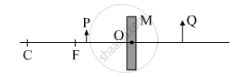
State the type of the mirror M and one characteristic property of the image Q.
Name the mirror that can give an erect and enlarged image of an object.
Three students A, B and C focussed a distant building on a screen with the help of a concave mirror. To determine focal length of the concave mirror they measured the distances as given below:
Student A : From mirror to the screen
Student B : From building to the screen
Student C : From building to the mirror
Who measured the focal length correctly ;
(a) Only A
(b) Only B
(c) A and B
(d) B and C
Fill in the following blank with suitable word:
Parallel rays of light are reflected by a concave mirror to a point called the ..........
Draw the following diagram in your answer book and show the formation of image with the help of suitable rays:
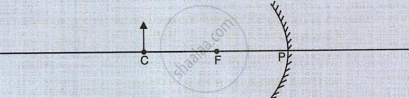
With the help of a ray diagram, determine the position, nature and size of the image formed of an object placed at the centre of curvature of a concave mirror.
The image formed by a concave mirror is real, inverted and highly diminished (much smaller than the object). The object must be:
(a) between pole and focus
(b) at focus
(c) at the centre of curvature
(d) at infinity
An object is placed at the following distances from a concave mirror of focal length 15 cm, turn by turn:
(a) 35 cm
(b) 30 cm
(c) 20 cm
(d) 10 cm
Which position of the object will produce:
(i) a magnified real image?
(ii) a magnified virtual image?
(iii) a diminished real image?
(iv) an image of same size as the object?
If an object of 10 cm height is placed at a distance of 36 cm from a concave mirror of focal length 12 cm, find the position, nature and height of the image.
State two uses of a concave mirror.
A student obtained a sharp inverted image of a distant tree on a screen placed in front of the concave mirror. He then removed the screen and tried to look into the mirror. He would now see
(A) a very blurred image on the wall opposite to the mirror
(B) an erect and magnified image of the tree in the mirror
(C) no image as the screen has been removed
(D) a highly diminished inverted image of the tree at the focus of the mirror.
Answer the following question:
An object is placed at a distance of 30 cm from a concave lens of focal length 30 cm.
(i) Use the lens formula to determine the distance of the image from the lens.
(ii) List four characteristics of the image (nature, position, size, erect/inverted) in this case.
(iii) Draw a labelled diagram to justify your answer of the part (ii)
Which of the following can make a parallel beam of light when light from a point source is incident on it?
Under which of the following conditions a concave mirror can form an image larger than the actual object?
Rays from Sun converge at a point 15 cm in front of a concave mirror. Where should an object be placed so that size of its image is equal to the size of the object?
State whether the following statement is True or False.
The sides of an object and its image formed by a concave mirror are always interchanged
______ mirrors magnify the object placed close to them.
Define principal focus of the concave mirror.
Which type of mirror is used in the following?
Floodlights
