Advertisements
Advertisements
प्रश्न
With the help of an appropriate ray diagram, state the sign conventions for reflection by a spherical mirror.
Advertisements
उत्तर
The sign convention for reflection by spherical mirrors is as follows:-
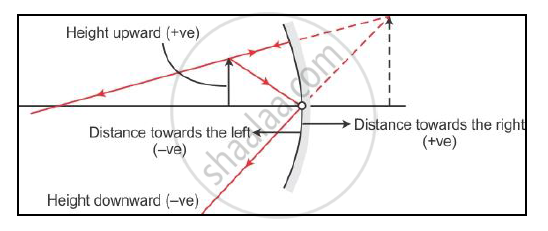
- The object is always placed to the left of the mirror.
- All distances parallel to the principal axis are measured from the pole of the mirror.
- All the distances measured to the right of the origin are taken as positive, while those measured to the left of the origin are taken as negative.
- Distances measured perpendicular to and above the principal axis are taken as positive.
- Distances measured perpendicular to and below the principal axis are taken as negative.
- The focal length of a convex mirror is positive, while that of a concave mirror is negative.
APPEARS IN
संबंधित प्रश्न
If the image formed by a mirror for all positions of the object placed in front of it is always erect and diminished, what type of mirror is it? Draw a ray diagram to justify your answer. Where and why do we generally use this type of mirror?
Draw a ray diagram to show the path of the reflected ray corresponding to an incident ray of light parallel to the principal axis of a convex mirror and show the angle of incidence and angle of reflection on it.
"A concave mirror of focal length 15 cm can form a magnified, erect as well as inverted image of an object placed in front of it." Justify this statement stating the position of the object with respect to the pole of the mirror in both the cases for obtaining the images.
To determine the approximate value of the focal length of a given concave mirror, you focus the image of a distant object formed by the mirror on a screen. The image obtained on the serene, as compared to the object is always:
(a) Laterally inverted and diminished
(b) Inverted and diminished
(c) Erect and diminished
(d) Erect and highly diminished
A concave mirror produces three times magnified image on a screen. If the object is placed 20 cm in front of the mirror, how far is the screen from the object.
State where an object must be placed so that the image formed by a concave mirror is:
(b) at infinity.
(c) the same size as the object.
Give two uses of concave mirrors. Explain why you would choose concave mirrors for these uses.
According to the “New Cartesian Sign Convention” for mirrors, what sign has been given to the focal length of:
- a concave mirror?
- a convex mirror?
What kind of mirror can have a focal length of, −20 cm?
Write down a formula for the magnification produced by a concave mirror.
In terms of height of object and height of image.
An object is 24 cm away from a concave mirror and its image is 16 cm from the mirror. Find the focal length and radius of curvature of the mirror, and the magnification of the image.
The mirror which can form a magnified image of an object is:
(a) convex mirror
(b) plane mirror
(c) concave mirror
(d) both convex and concave mirror
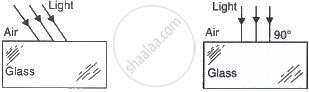
Draw and complete the following diagrams to show what happens to the beams of light as they enter the glass block and then leave it:
A student obtained a sharp inverted image of a distant tree on a screen placed in front of the concave mirror. He then removed the screen and tried to look into the mirror. He would now see
(A) a very blurred image on the wall opposite to the mirror
(B) an erect and magnified image of the tree in the mirror
(C) no image as the screen has been removed
(D) a highly diminished inverted image of the tree at the focus of the mirror.
List four characteristics of the image formed by a concave mirror of focal length 40 cm when the object is placed in front of it at a distance of 20 cm from its pole.
Match the following.
| Convex mirror | Radio telescopes |
| Parobolic mirror | Rear – view mirror |
| Snell’s law | Kaleidoscope |
| Dispersion of light | sin i/sin r =μ |
| Refractive index | Rainbow |
The radius of curvature of a concave mirror whose focal length is 5cm is ______
According to cartesion sign convention, which mirror and which lens has negative focal length?
The concave reflecting surface of a torch got rusted. What effect would this have on the beam of light from the torch?
In the headlights of motor vehicles, ______ mirrors are used as reflectors.
