Advertisements
Advertisements
Question
Which type of mirror is used in the following?
Floodlights
Advertisements
Solution
Concave mirror
APPEARS IN
RELATED QUESTIONS
With the help of an appropriate ray diagram, state the sign conventions for reflection by a spherical mirror.
Consider the following diagram in which M is a mirror and P is an object and Q is its magnified image formed by the mirror.
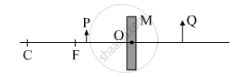
State the type of the mirror M and one characteristic property of the image Q.
A student wants to project the image of a candle flame on a screen 48 cm in front of a mirror by keeping the flame at a distance of 12 cm from its pole.
(a) Suggest the type of mirror he should use.
(b) Find the linear magnification of the image produced.
(c) How far is the image from its object?
(d) Draw ray diagram to show the image formation in this case.
Draw a ray diagram to show the path of the reflected ray corresponding to an incident ray of light parallel to the principal axis of a concave mirror. Mark the angle of incidence and angle of reflection on it.
An object of size 7.0 cm is placed at 27 cm in front of a concave mirror of focal length 18 cm. At what distance from the mirror should a screen be placed, so that a sharp focused image can be obtained? Find the size and the nature of the image.
An object 4 cm in height, is placed at 15 cm in front of a concave mirror of focal length 10 cm. At what distance from the mirror should a screen be placed to obtain a sharp image of the object. Calculate the height of the image.
What is a spherical mirror?
With the help of a ray diagram, determine the position, nature and size of the image formed of an object placed at the centre of curvature of a concave mirror.
Make labelled ray diagrams to illustrate the formation of:
a virtual image by a converging mirror.
Mark clearly the pole, focus, centre of curvature and position of object in each case.
According to New Cartesian Sign Convention:
(a) focal length of concave mirror is positive and that of convex mirror is negative
(b) focal length of both concave and convex mirrors is positive
(c) focal length of both concave and convex mirrors is negative
(d) focal length of concave mirror is negative and that of convex mirror is positive
Write down a formula for the magnification produced by a concave mirror.
In terms of height of object and height of image.
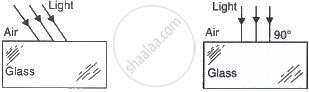
Draw and complete the following diagrams to show what happens to the beams of light as they enter the glass block and then leave it:
State two uses of a concave mirror.
A student determines the focal length of a device 'X' by focusing the image of a distant object on a screen placed 20 cm from the device on the same side as the object. The device 'X' is
(a) Concave lens of focal length 10 cm
(b) Convex lens of focal length 20 cm
(c) Concave mirror of focal length 10 cm
(d) Concave mirror of focal length 20 cm
List four characteristics of the image formed by a concave mirror of focal length 40 cm when the object is placed in front of it at a distance of 20 cm from its pole.
The radius of curvature of a concave mirror whose focal length is 5cm is ______
Name the mirror(s) that can give (i) an erect and enlarged image, (ii) same sized, inverted image
Pick out the concave and convex mirrors from the following and tabulate them.
Rear-view mirror, Dentist’s mirror, Torchlight mirror, Mirrors in shopping malls, Make-up mirror.
You are provided with a convex mirror, a concave mirror, a convex lens and a concave lens. You can get an inverted image from
A student wants to obtain an erect image of an object using a concave mirror of 10 cm focal length. What will be the distance of the object from mirror?
