Advertisements
Advertisements
प्रश्न
Why are concave mirrors used in solar devices?
Advertisements
उत्तर
A concave mirror is also known as a converging mirror because of its ability to focus parallel rays of light at a single point on its focal plane. This property is used in solar devices. Parallel rays from the Sun, when reflected by the concave mirror, are focused at a particular point, generating a significant amount of heat. This heat is essential for the proper functioning of solar devices, such as solar cookers or solar furnaces.
APPEARS IN
संबंधित प्रश्न
An object of height 5 cm is placed perpendicular to the principal axis of a concave lens of focal length 10 cm. If the distance of the object from the optical centre of the lens is 20 cm, determine the position, nature and size of the image formed using the lens formula.
For what position of an object, a real and diminished image is formed by a concave mirror?
Draw the following diagram in your answer book and show the formation of image of the object AB with the help of suitable rays:

The focal length of a small concave mirror is 2.5 cm. In order to use this concave mirror as a dentist's mirror, the distance of tooth from the mirror should be:
(a) 2.5 cm
(b) 1.5 cm
(c) 4.5 cm
(d) 3.5 cm
A concave mirror has a focal length of 25 cm. At which of the following distance should a person hold his face from this concave mirror so that it may act as a shaving mirror?
(a) 45 cm
(b) 20 cm
(c) 25 cm
(d) 30 cm
Give reason for your choice.
An object 3 cm high is placed at a distance of 8 cm from a concave mirror which produces a virtual image 4.5 cm high:
(i) What is the focal length of the mirror?
(ii) What is the position of image?
(iii) Draw a ray-diagram to show the formation of image.
A large concave mirror has a radius of curvature of 1.5 m. A person stands 10 m in front of the mirror. Where is the person's image?
How far should an object be placed from the pole of a converging mirror of focal length 20cm to form a real image of the size exactly `1/4`th the size of the object?
At what distance from a concave mirror of focal length 10 cm should an object be placed so that:
its real image is formed 20 cm from the mirror?
What would your image look like if you stood close to a large:
concave mirror?
Which of the following are concave mirrors and which convex mirrors?
Shaving mirrors, Car headlight mirror, Searchlight mirror, Driving mirror, Dentist’s inspection mirror, Torch mirror, Staircase mirror in a double-decker bus, Make-up mirror, Solar furnace mirror, Satellite TV dish, Shop security mirror.
The image formed by a concave mirror is of the same size as the object, if the object is placed
Complete the following diagrams in figure by drawing the reflected rays for the incident rays 1 and 2 if F is the focus and C is the centre of curvature.
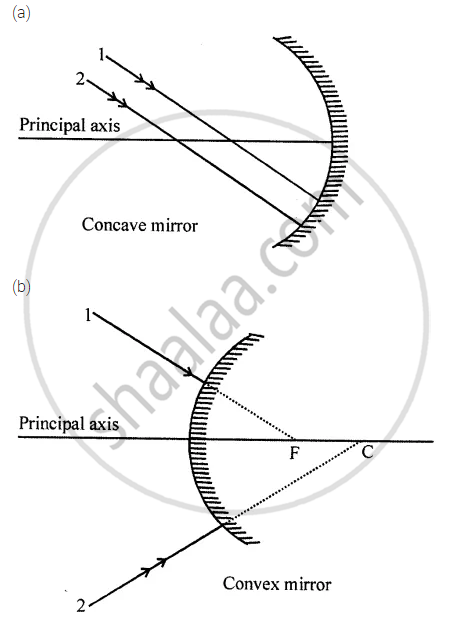
Draw a ray diagram to show the formation of image of an object placed at the centre of curvature of a concave mirror. State the position, size and nature of the image.
A student has to trace the path of a ray of light passing through a rectangular glass slab for four different values of angle of incidence.
(a) Write two important precautions for this experiment.
(b) List two conclusions the student will draw based on his experiment.
Why does obtaining the image of the sun on paper with the help of a concave mirror burn the paper?
A child is standing in front of a magic mirror. She finds the image of her head bigger, the middle portion of her body of the same size and that of the legs smaller. The following is the order of combinations for the magic mirror from the top.
The mirror having reflecting surface curved inwards ______.
You are provided with a concave mirror, a convex mirror, a concave lens and a convex lens. To obtain an enlarged image of an object you can use either
The concave reflecting surface of a torch got rusted. What effect would this have on the beam of light from the torch?
