Advertisements
Advertisements
प्रश्न
Describe the positions of the source of light with respect to a concave mirror in Floodlight.
Advertisements
उत्तर
In a floodlight, the light source is slightly beyond the radius of curvature, which gives us the right light.
APPEARS IN
संबंधित प्रश्न
With the help of an appropriate ray diagram, state the sign conventions for reflection by a spherical mirror.
Draw a ray diagram to show the path of the reflected ray corresponding to an incident ray of light parallel to the principal axis of a convex mirror and show the angle of incidence and angle of reflection on it.
An object of height 5 cm is placed perpendicular to the principal axis of a concave lens of focal length 10 cm. If the distance of the object from the optical centre of the lens is 20 cm, determine the position, nature and size of the image formed using the lens formula.
It is desired to obtain an erect image of an object, using concave mirror of focal length of 12 cm.
Will the image be smaller or larger than the object? Draw ray diagram to show the formation of image in this case.
Draw ray diagrams to show the principal focus of a convex mirror.
List four specific characteristics of the images of the objects formed by convex mirrors.
A concave mirror produces three times magnified (enlarged) real image of object placed at 10 cm in front of it. Where is the image located?
An object is placed at a distance of 12 cm in front of a concave mirror of radius of curvature 30 cm. List four characteristics of the image formed by the mirror.
Define the principal focus of a concave mirror.
If an object is at infinity (very large distance) in front of a concave mirror, where is the image formed?
Which kind of mirror is used in the headlights of a car? Why is it used for this purpose?
Draw a ray diagram showing how a concave mirror can be used to produce a real, inverted and diminished image of an object.
Which mirror is used as a torch reflector? Draw a labelled diagram to show how a torch reflector can be used to produce a parallel beam of light. Where is the bulb placed in relation to the torch reflector?
- Draw ray-diagrams to show the formation of images when the object is placed in front of a concave mirror (converging mirror):
- between its pole and focus
- between its centre of curvature and focus.
Describe the nature, size and position of the image formed in each case.
- State one use of concave mirror based on the formation of image as in case (i) above.
between its pole and focus
Describe the nature, size and position of the image formed in each case.
State one use of concave mirror bases on the formation of image as in case (i) above.
The real image formed by a concave mirror is larger than the object when object is:
(a) at a distance equal to radius of curvature
(b) at a distance less than the focal length
(c) between focus and centre of curvature
(d) at a distance greater than radius of curvature
The focal length of a small concave mirror is 2.5 cm. In order to use this concave mirror as a dentist's mirror, the distance of tooth from the mirror should be:
(a) 2.5 cm
(b) 1.5 cm
(c) 4.5 cm
(d) 3.5 cm
An object is 100 mm in front of a concave mirror which produces an upright (erect image). The radius of curvature of the mirror is ______.
According to the “New Cartesian Sign Convention” for mirrors, what sign has been given to the focal length of:
- a concave mirror?
- a convex mirror?
What is the position of the image when an object is placed at a distance of 20 cm from a concave mirror of focal length 20 cm?
Between which two points of concave mirror should an object be placed to obtain a magnification of:
(a) −3
(b) +25
(c) −0.4
At what distance from a concave mirror of focal length 10 cm should an object be placed so that:
its real image is formed 20 cm from the mirror?
What type of image/images are formed by:
a convex mirror?
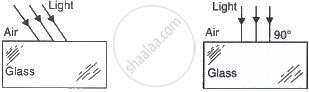
Draw and complete the following diagrams to show what happens to the beams of light as they enter the glass block and then leave it:
Radius of curvature of a spherical mirror is ............. its focal length.
Draw a ray diagram to show the formation of the image of an object placed beyond the centre of curvature of a concave mirror. State the position, size and nature of the image.
A student determines the focal length of a device 'X' by focusing the image of a distant object on a screen placed 20 cm from the device on the same side as the object. The device 'X' is
(a) Concave lens of focal length 10 cm
(b) Convex lens of focal length 20 cm
(c) Concave mirror of focal length 10 cm
(d) Concave mirror of focal length 20 cm
______ is used as reflectors in torchlight.
A 10 mm long awl pin is placed vertically in front of a concave mirror. A 5 mm long image of the awl pin is formed at 30 cm in front of the mirror. The focal length of this mirror is ______.
Under which of the following conditions a concave mirror can form an image larger than the actual object?
Rays from Sun converge at a point 15 cm in front of a concave mirror. Where should an object be placed so that size of its image is equal to the size of the object?
A child is standing in front of a magic mirror. She finds the image of her head bigger, the middle portion of her body of the same size and that of the legs smaller. The following is the order of combinations for the magic mirror from the top.
The mirror having reflecting surface curved inwards ______.
A concave mirror of radius 30 cm is placed in water. It’s focal length in air and water differ by ______.

While looking at the above diagram, Nalini concluded the following.
- the image of the object will be a virtual one.
- the reflected ray will travel along the same path as the incident ray but in opposite direction.
- the image of the object will be inverted.
- this is a concave mirror and hence the focal length will be negative.
Which one of the above statements are correct?
You are provided with a concave mirror, a convex mirror, a concave lens and a convex lens. To obtain an enlarged image of an object you can use either
An image formed by a lens is erect. Such an image could be formed by a
______ mirrors magnify the object placed close to them.
