Advertisements
Advertisements
प्रश्न
Differentiate between resistances in series and parallel.
Advertisements
उत्तर
| Resistances in Series | Resistances in Parallel | ||
| 1 | In this type of connection, the resistances are connected one after the other such that the same amount of current flows through each resistance. | 1 | In this type of connection, the resistances are connected between two common points such that the potential difference across each resistor is the same. |
| 2 | For n number of resistors connected in series, the effective resistance RS is equal to the sum of the individual resistors. RS = R1 + R2 + R3 + R4+ …… Rn |
2 |
For n number of resistors connected in pparallel, the reciprocal of the effective resistance (Rp) is equal to the sum of the reciprocals of the individual resistances. `1/R_p=1/R_1+1/R_2+..............+1/R_p`
|
| 3 | The effective resistance in series combination is greater than the individual resistances. | 3 | The effective resistance in parallel combination is less than the individual resistances in the combination. |
| 4 | It is used to decrease the current in the circuit. | 4 | It is used to increase the current in the circuit. |
APPEARS IN
संबंधित प्रश्न
With a neat labelled diagram and derive the equation for three resistances connected in parallel.
How can three resistors of resistances 2 Ω, 3 Ω and 6 Ω be connected to give a total resistance of 4 Ω ?
How many 176 Ω resistors (in parallel) are required to carry 5 A on a 220 V line?
Explain with the help of a labelled circuit diagram, how you will find the resistance of a combination of three resistors of resistances R1, R2 and R3 joined in parallel.
In the diagram shown alongside, the cell and the ammeter both have negligible resistance. The resistors are identical.
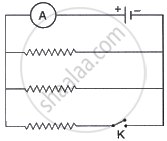
With the switch K open, the ammeter reads 0.6 A. What will be the ammeter reading when the switch is closed?
The figure given below shows three resistors?
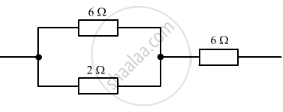
Their combined resistance is:
(a) `1 5/7`Ω
(b) `14` Ω
(c) `6 2/3` Ω
(d) `7 1/2` Ω
You are given three resistances of 1, 2 and 3 ohms. Shows by diagrams, how with the help of these resistances you can get:
(i) 6 Ω
(ii) `6/1` Ω
(iii) 1.5 Ω
In parallel combination of resistances ______.
Calculate the equivalent resistance between the points A and B in Fig. if each resistance is 2·0 Ω.

What are the advantages of a parallel connection?
Explain, why is the p.d. between the terminals of a storage battery less when it is supplying current than when it is on open circuit. A battery of e.m.f. 10 volts and internal resistance 2.5 ohms has two resistances of 50 ohms each connected to it. Calculate the power dissipated in each resistance
(a) When they are in series,
(b) When they are in parallel.
In each case calculate the power dissipated in the battery.
Tick (✓) the correct choice among the following :
Consider two cases of two parallel current carrying conductors. Current in
th e same direction and currents in th e opposi te directions will produce
A cell supplies a current of 1.2 A through two 2Ω resistors connected in parallel. When the resistors are connected in series, if supplies a current of 0.4 A. Calculate the internal resistance and e.m.f of the cell.
A particular resistance wire has a resistance of 3 ohm per meter. Find the potential difference of the battery which gives a current of 2 A in each of the 1.5 m length when connected in the parallel to the battery (assume that resistance of the battery is negligible).
A current of 2 A is passed through a coil of resistance 75 Ω for 2 minutes.
(a) How much heat energy is produced?
(b) How much charge is passed through the resistance?
How does the resistance of a metallic wire depend on the thickness of wire?
Two devices are connected between two points say A and B in parallel. The physical quantity that will remain the same between the two points is:
Calculate the current flows through the 10 Ω resistor in the following circuit.

Three resistors of 1 Ω, 2 Ω and 3 Ω are connected in parallel. The combined resistance of the three resistors should be:
Two resistors of resistance 2 Ω and 3 Ω are connected in parallel to a cell to draw current 0.5 A from the cell. Calculate the current in each resistor.
