Advertisements
Advertisements
प्रश्न
Tick (✓) the correct choice among the following :
Consider two cases of two parallel current carrying conductors. Current in
th e same direction and currents in th e opposi te directions will produce
विकल्प
Attraction and repulsion respectively
Repulsion and attraction respectively,
Attraction in both cases
Repulsion in both cases
Osci llation in both cases
Advertisements
उत्तर
Repulsion and attraction respectively,
APPEARS IN
संबंधित प्रश्न
State the law of combination of resistances in parallel.
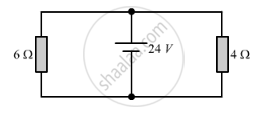
Find the current in each resistor in the circuit shown below:
In the diagram shown alongside, the cell and the ammeter both have negligible resistance. The resistors are identical.
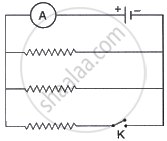
With the switch K open, the ammeter reads 0.6 A. What will be the ammeter reading when the switch is closed?
A combination consists of three resistors in series. Four similar sets are connected in parallel. If the resistance of each resistor is 2 ohm, find the resistance of the combination.
A uniform wire with a resistance of 27 Ω is divided into three equal pieces and then they are joined in parallel. Find the equivalent resistance of the parallel combination.
The equivalent resistance of a parallel combination of two resistors of 30 Ω and 60 Ω is ______________.
How does the resistance of a metallic wire depend on the thickness of wire?
What connection is used in domestic appliances and why?
Study the following circuit:

On the basis of this circuit, answer the following questions:
i. Find the value of total resistance between the points A and B.
ii. Find the resistance between the points B and C.
iii. Calculate the current drawn from the battery, when the key is closed
OR
iii. In the above circuit, the 16Ω resistor or the parallel combination of two resistors of 8 Ω, which one of the two will have more potential difference across its two ends? Justify your answer.
Two resistors of resistances 2 Ω and 3 Ω are connected in parallel to a cell to draw current 0.5 A from the cell. Draw a labelled diagram of the arrangement
