Advertisements
Advertisements
प्रश्न
A combination consists of three resistors in series. Four similar sets are connected in parallel. If the resistance of each resistor is 2 ohm, find the resistance of the combination.
Advertisements
उत्तर
Resistance of each set:
1r = 2 + 2 + 2 = 6 ohm
2r = 2 + 2 + 2 = 6 ohm
3r = 2 + 2 + 2 = 6 ohm
4r = 2 + 2 + 2 = 6 ohm
Now these resistances are arranged in parallel :
`1/r=1/r_1+1/r_2+1/r_3+1/r_4`
`1/r=1/6+1/6+1/6+1/6`
`r=6/4=1.5 ohm `
संबंधित प्रश्न
With a neat labelled diagram and derive the equation for three resistances connected in parallel.
Several electric bulbs designed to be used on a 220 V electric supply line are rated 10 W. How many lamps can be connected in parallel with each other across the two wires of 220 V line if the maximum allowable current is 5 A?
State how are the two resistors joined with a battery when potential difference is same across each resistor.
Two resistors having resistance 4𝛀 and 6𝛀 are connected in parallel. Find their equivalent resistance.
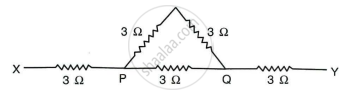
Five resistors, each 3 Ω, are connected as shown in Fig. Calculate the resistance
- between the points P and Q.
- between the points X and Y.
A particular resistance wire has a resistance of 3 ohm per meter. Find the total resistance of three lengths of this wire each 1.5 m long, joined in parallel.
A battery of e.m.f 16 V and internal resistance 2 Ω is connected to two resistors 3Ω and 6Ω connected in parallel. Find:
- the current through the battery.
- p.d. between the terminals of the battery,
- the current in 3 Ω resistors,
- the current in 6 Ω resistor.
Two resistors of resistance 4 Ω and 6 Ω are connected in parallel to a cell to draw 0.5 A current from the cell.
Calculate current in each resistor.
A coil in the heater consumes power P on passing current. If it is cut into halves and joined in parallel, it will consume power:
