Advertisements
Advertisements
प्रश्न
A combination consists of three resistors in series. Four similar sets are connected in parallel. If the resistance of each resistor is 2 ohm, find the resistance of the combination.
Advertisements
उत्तर
Resistance of each set:
1r = 2 + 2 + 2 = 6 ohm
2r = 2 + 2 + 2 = 6 ohm
3r = 2 + 2 + 2 = 6 ohm
4r = 2 + 2 + 2 = 6 ohm
Now these resistances are arranged in parallel :
`1/r=1/r_1+1/r_2+1/r_3+1/r_4`
`1/r=1/6+1/6+1/6+1/6`
`r=6/4=1.5 ohm `
संबंधित प्रश्न
Find the current in each resistor in the circuit shown below:
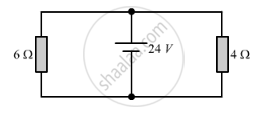
Explain with diagram what is meant by the "series combination" and "parallel combination" of resistances. In which case the resultant resistance is : (i) less, and (ii) more, than either of the individual resistances?
An electric heater which is connected to a 220 V supply line has two resistance coils A and B of 24 Ω resistance each. These coils can be used separately (one at a time), in series or in parallel. Calculate the current drawn when:
(a) only one coil A is used.
(b) coils A and B are used in series.
(c) coils A and B are uses in parallel.
Which of the following combinations have the same equivalent resistance between X and Y?
You have three resistors of values 2Ω, 3Ω and 5Ω. How will you join them so that the total resistance is less than 1Ω? Draw diagram and find the total resistance.
What is the equivalent resistance of 5 equal resistors, each of value 2`Omega` 1 when oonnected in (a) Series ( b) ParaIleI?
Two resistors of resistance 4 Ω and 6 Ω are connected in parallel to a cell to draw 0.5 A current from the cell.
Calculate current in each resistor.
An electrical appliance has a rating 100 W, 120V. The resistance of element of appliance when in use:
A piece of wire of resistance R is cut into three equal parts. These parts are then connected in parallel. If the equivalent resistance of this parallel combination is R1, what is the value of the ratio R1 : R?
A particular resistance wire has a resistance of 3·0 ohm per metre. Find the resistance of 5 m length of a wire of the same material, but with twice the area of cross section.
