Advertisements
Advertisements
प्रश्न
An electrical appliance has a rating 100 W, 120V. The resistance of element of appliance when in use:
पर्याय
1.2 Ω
144 Ω
120 Ω
100 Ω
Advertisements
उत्तर
144 Ω
Given , Power (P) = 100 W
Potential difference , V = 120 volt
∴ Resistance , R = `("V"^2)/"P" = (120)^2/100 = 144 Ω`
संबंधित प्रश्न
The equivalent resistance of the parallel combination of two resistors of 60Ω and 40Ω is _______.
A) 24Ω
(B) 100Ω
(C) 50 Ω
(D) 240Ω
State the law of combination of resistances in parallel.
A resistor has a resistance of 176 ohms. How many of these resistors should be connected in parallel so that their combination draws a current of 5 amperes from a 220 volt supply line?
Are the lights in your house wired in series?
Four resistors each of resistance 2Ω are connected in parallel. What is the effective resistance?
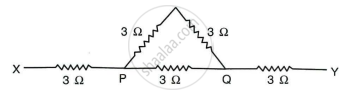
Five resistors, each 3 Ω, are connected as shown in Fig. Calculate the resistance
- between the points P and Q.
- between the points X and Y.
A particular resistance wire has a resistance of 3 ohm per meter. Find the total resistance of three lengths of this wire each 1.5 m long, joined in parallel.
A particular resistance wire has a resistance of 3 ohm per meter. Find the potential difference of the battery which gives a current of 2 A in each of the 1.5 m length when connected in the parallel to the battery (assume that resistance of the battery is negligible).
An electrical appliance having a resistance of 200 Ω is operated at 200 V. Calculate the energy consumed by the appliance in 5 minutes in kWh.
Two resistors having resistance 8 Ω and 12 Ω are connected in parallel. Find their equivalent resistance.
