Advertisements
Advertisements
प्रश्न
State the law of combination of resistances in parallel.
Advertisements
उत्तर
In a parallel combination, the voltage remains the same across each resistor but the current gets divided. Let I1, I2 and I3 be the current across resistors R1, R2 and R3, respectively.
`l=l_1+l_2+l_3`
`V=LR,V=L_1R_1,L_2R_2, V=L_3R_3`
`I=v/R,I_1 V/R_1, I_2=V/R_2,L_3 V/R_1`
Using thrsr value, We get:
`V/R=V/R_1+V/R_2+V/R^1`
`1/R=1/R_1+1/R_2+1/R_1`
So, the total resistance is the sum of the reciprocal of the individual resistances.
APPEARS IN
संबंधित प्रश्न
A wire that has resistance R is cut into two equal pieces. The two parts are joined in parallel. What is the resistance of the combination?
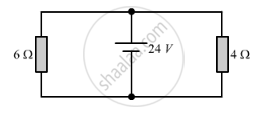
Find the current in each resistor in the circuit shown below:
Explain with diagram what is meant by the "series combination" and "parallel combination" of resistances. In which case the resultant resistance is : (i) less, and (ii) more, than either of the individual resistances?
An electric heater which is connected to a 220 V supply line has two resistance coils A and B of 24 Ω resistance each. These coils can be used separately (one at a time), in series or in parallel. Calculate the current drawn when:
(a) only one coil A is used.
(b) coils A and B are used in series.
(c) coils A and B are uses in parallel.
Show with the help of diagrams, how you would connect three resistors each of resistance 6 Ω, so that the combination has resistance of (i) 9 Ω (ii) 4 Ω.
How will you connect three resistors of resistances 2 Ω, 3 Ω, and 6 Ω to obtain a total resistance of 4 Ω, and 1 Ω?
State how are the two resistors joined with a battery when equivalent resistance is less than either of the two resistances.
Calculate the equivalent resistance between the points A and B in Fig. if each resistance is 2·0 Ω.

A combination consists of three resistors in series. Four similar sets are connected in parallel. If the resistance of each resistor is 2 ohm, find the resistance of the combination.
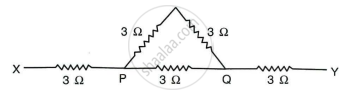
Five resistors, each 3 Ω, are connected as shown in Fig. Calculate the resistance
- between the points P and Q.
- between the points X and Y.
The circuit diagram Fig shows three resistors 2 Ω, 4 Ω and R Ω connected to a battery of e.m.f. 2 V and internal resistance 3 Ω. If main current of 0.25 A flows through the circuit, find:
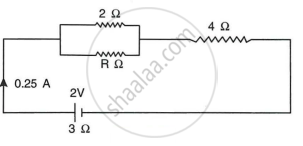
- the p.d. across the 4 Ω resistor,
- the p.d. across the internal resistance of the cell,
- the p.d. across the R Ω or 2 Ω resistors
- the value of R.
State the S.I. unit of electrical resistance and define it.
A given wire is stretched to double its length. How will its resistance change?
Two devices are connected between two points say A and B in parallel. The physical quantity that will remain the same between the two points is:
Two V-I graphs A and B for series and parallel combinations of two resistors are as shown. Giving reason state which graph shows (a) series, (b) parallel combination of the resistors.

A piece of wire of resistance R is cut into three equal parts. These parts are then connected in parallel. If the equivalent resistance of this parallel combination is R1, what is the value of the ratio R1 : R?
Four resistors each of resistance 5 Ω are connected in parallel. What is the effective resistance?
Two resistors of resistances 2 Ω and 3 Ω are connected in parallel to a cell to draw current 0.5 A from the cell. Draw a labelled diagram of the arrangement
Two resistors of resistance 2 Ω and 3 Ω are connected in parallel to a cell to draw current 0.5 A from the cell. Calculate the current in each resistor.
A particular resistance wire has a resistance of 3·0 ohm per metre. Find the resistance of 5 m length of a wire of the same material, but with twice the area of cross section.
