Advertisements
Advertisements
प्रश्न
Explain with diagram what is meant by the "series combination" and "parallel combination" of resistances. In which case the resultant resistance is : (i) less, and (ii) more, than either of the individual resistances?
Advertisements
उत्तर
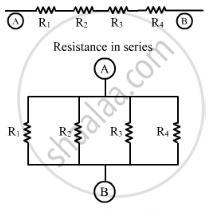
The series resistance is given by R = R1 + R2 + R3 + R4. Hence, it is more than the individual resistance.
The parallel resistance is given by 1 / R = 1 / R1 + 1 / R2 + 1 / R3 + 1 / R4. Hence, it is less than the individual resistance.
APPEARS IN
संबंधित प्रश्न
Two resistors, with resistance 5 Ω and 10 Ω respectively are to be connected to a battery of emf 6 V so as to obtain:
(i) minimum current flowing
(ii) maximum current flowing
(a) How will you connect the resistances in each case?
(b) Calculate the strength of the total current in the circuit in the two cases.
Explain with the help of a labelled circuit diagram, how you will find the resistance of a combination of three resistors of resistances R1, R2 and R3 joined in parallel.
How will you connect three resistors of 2 Ω, 3 Ω and 5 Ω respectively so as to obtain a resultant of 2.5 Ω? Draw the diagram to show the arrangement.
How will you connect three resistors of resistances 2 Ω, 3 Ω, and 6 Ω to obtain a total resistance of 4 Ω, and 1 Ω?
State how are the two resistors joined with a battery when equivalent resistance is less than either of the two resistances.
Four resistors each of resistance 2Ω are connected in parallel. What is the effective resistance?
A battery of e.m.f. 15 V and internal resistance 2 `Omega` is connected to two resistors of 4 ohm and 6 ohm joined.
(i) In series,
(ii) In parallel.
Find in each case the electrical energy spent per minute in 6 ohm resistor.
A cell supplies a current of 1.2 A through two 2Ω resistors connected in parallel. When the resistors are connected in series, if supplies a current of 0.4 A. Calculate the internal resistance and e.m.f of the cell.
An electrical appliance has a rating 100 W, 120V. The resistance of element of appliance when in use:
A current of 2 A is passed through a coil of resistance 75 Ω for 2 minutes.
(a) How much heat energy is produced?
(b) How much charge is passed through the resistance?
An electrical appliance having a resistance of 200 Ω is operated at 200 V. Calculate the energy consumed by the appliance in 5 minutes in kWh.
Solve the following question:
In an electric circuit, two resistors of 12 0 each are joined in parallel to a 6 V battery. Find the current drawn from the battery.
How does the resistance of a metallic wire depend on the length of wire?
Two resistors when connected in parallel give the resultant resistance of 2 ohms, but when connected in series the effective resistance becomes 9 ohms. Calculate the value of each resistance.

The diagram above is a schematic diagram of a household circuit. The house shown in the above diagram has 5 usable spaces where electrical connections are made. For this house, the mains have a voltage of 220 V and the net current coming from the mains is 22A.
- What is the mode of connection to all the spaces in the house from the mains?
- The spaces 5 and 4 have the same resistance and spaces 3 and 2 have respective resistances of 20Ω and 30Ω. Space 1 has a resistance double that of space 5. What is the net resistance for space 5.
- What is the current in space 3?
- What should be placed between the main connection and the rest of the house’s electrical appliances to save them from accidental high electric current?
Two V-I graphs A and B for series and parallel combinations of two resistors are as shown. Giving reason state which graph shows (a) series, (b) parallel combination of the resistors.

A piece of wire of resistance R is cut into three equal parts. These parts are then connected in parallel. If the equivalent resistance of this parallel combination is R1, what is the value of the ratio R1 : R?
You have three resistors of values 2 Ω, 3 Ω, and 5 Ω. How will you join them so that the total resistance is less than 1 Ω? Draw a diagram and find the total resistance.
