Advertisements
Advertisements
Question
Explain with diagram what is meant by the "series combination" and "parallel combination" of resistances. In which case the resultant resistance is : (i) less, and (ii) more, than either of the individual resistances?
Advertisements
Solution
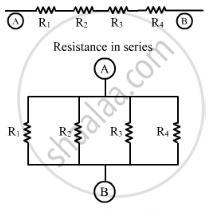
The series resistance is given by R = R1 + R2 + R3 + R4. Hence, it is more than the individual resistance.
The parallel resistance is given by 1 / R = 1 / R1 + 1 / R2 + 1 / R3 + 1 / R4. Hence, it is less than the individual resistance.
APPEARS IN
RELATED QUESTIONS
Complete the following :-
(c)

What are the advantages of connecting electrical devices in parallel with the battery instead of connecting them in series?
Several electric bulbs designed to be used on a 220 V electric supply line are rated 10 W. How many lamps can be connected in parallel with each other across the two wires of 220 V line if the maximum allowable current is 5 A?
A wire that has resistance R is cut into two equal pieces. The two parts are joined in parallel. What is the resistance of the combination?
In the diagram shown alongside, the cell and the ammeter both have negligible resistance. The resistors are identical.
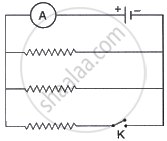
With the switch K open, the ammeter reads 0.6 A. What will be the ammeter reading when the switch is closed?
In parallel combination of resistances ______.
Two resistors having resistance 4𝛀 and 6𝛀 are connected in parallel. Find their equivalent resistance.
Calculate the equivalent resistance between the points A and B in Fig. if each resistance is 2·0 Ω.

A particular resistance wire has a resistance of 3 ohm per meter. Find the total resistance of three lengths of this wire each 1.5 m long, joined in parallel.
A battery of e.m.f. 15 V and internal resistance 2 `Omega` is connected to two resistors of 4 ohm and 6 ohm joined.
(i) In series,
(ii) In parallel.
Find in each case the electrical energy spent per minute in 6 ohm resistor.
Tick (✓) the correct choice among the following :
Consider two cases of two parallel current carrying conductors. Current in
th e same direction and currents in th e opposi te directions will produce
Two resistors of resistance 4 Ω and 6 Ω are connected in parallel to a cell to draw 0.5 A current from the cell.
Draw a labeled diagram of the arrangement
Two resistors of resistance 4 Ω and 6 Ω are connected in parallel to a cell to draw 0.5 A current from the cell.
Calculate current in each resistor.
How does the resistance of a metallic wire depend on the length of wire?
A coil in the heater consumes power P on passing current. If it is cut into halves and joined in parallel, it will consume power:
Assertion: When a battery is short circuited, the terminal voltage is zero.
Reason: In a short circuit, the current is zero.
Three resistors of 6Ω, 4Ω and 4Ω are connected together so that the total resistance is 8Ω. Draw a diagram to show this arrangement and give reason to justify your answer.
You have three resistors of values 2 Ω, 3 Ω, and 5 Ω. How will you join them so that the total resistance is less than 1 Ω? Draw a diagram and find the total resistance.
Two resistors of resistance 2 Ω and 3 Ω are connected in parallel to a cell to draw current 0.5 A from the cell. Calculate the current in each resistor.
