Advertisements
Advertisements
Question
How does the resistance of a metallic wire depend on the length of wire?
Advertisements
Solution
The resistance of a wire increases with increases in the length of wire (R ∝ l).
RELATED QUESTIONS
Two resistors, with resistance 5 Ω and 10 Ω respectively are to be connected to a battery of emf 6 V so as to obtain:
(i) minimum current flowing
(ii) maximum current flowing
(a) How will you connect the resistances in each case?
(b) Calculate the strength of the total current in the circuit in the two cases.
How will you connect three resistors of 2 Ω, 3 Ω and 5 Ω respectively so as to obtain a resultant of 2.5 Ω? Draw the diagram to show the arrangement.
How will you connect three resistors of resistances 2 Ω, 3 Ω, and 6 Ω to obtain a total resistance of 4 Ω, and 1 Ω?
Are the lights in your house wired in series?
State how are the two resistors joined with a battery when potential difference is same across each resistor.
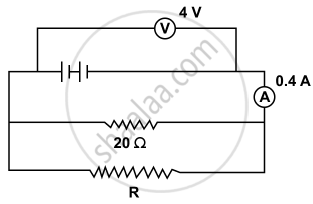
In the following figure calculate:
- the total resistance of the circuit
- the value of R, and
- the current flowing in R.
What are the advantages of a parallel connection?
Two resistors of resistance 4 Ω and 6 Ω are connected in parallel to a cell to draw 0.5 A current from the cell.
Draw a labeled diagram of the arrangement
Two resistors when connected in parallel give the resultant resistance of 2 ohms, but when connected in series the effective resistance becomes 9 ohms. Calculate the value of each resistance.
The least resistance obtained by using 2 Ω, 4 Ω, 1 Ω and 100 Ω is:
