Advertisements
Advertisements
Question
A wire of resistance R1 is cut into five equal pieces. These five pieces of wire are then connected in parallel. If the resultant resistance of this combination be R2, then the ratio `R_1/R_2` is:
(a) `1/25`
(b)1/5
(c)5
(c)25
Advertisements
Solution
(d) 25
If the resistance wire is cut into five pieces, the resistance of each wire is R/5. If we connect the pieces in parallel, we will get the net resistance as R/25. Therefore, the ratio will be 25.
APPEARS IN
RELATED QUESTIONS
How can three resistors of resistances 2 Ω, 3 Ω and 6 Ω be connected to give a total resistance of 4 Ω ?
State the law of combination of resistances in parallel.
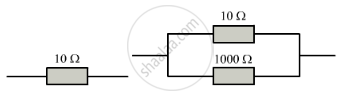
Which of the following arrangement, A or B, has the lower combined resistance?
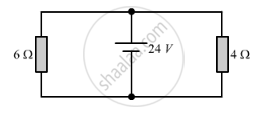
Find the current in each resistor in the circuit shown below:
State how are the two resistors joined with a battery when equivalent resistance is less than either of the two resistances.
What are the advantages of a parallel connection?
A cell supplies a current of 1.2 A through two 2Ω resistors connected in parallel. When the resistors are connected in series, if supplies a current of 0.4 A. Calculate the internal resistance and e.m.f of the cell.
The circuit diagram Fig shows three resistors 2 Ω, 4 Ω and R Ω connected to a battery of e.m.f. 2 V and internal resistance 3 Ω. If main current of 0.25 A flows through the circuit, find:
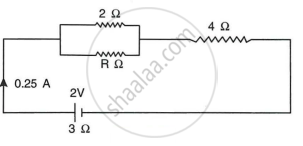
- the p.d. across the 4 Ω resistor,
- the p.d. across the internal resistance of the cell,
- the p.d. across the R Ω or 2 Ω resistors
- the value of R.
A particular resistance wire has a resistance of 3 ohm per meter. Find :
The total resistance of three lengths of this wire each 1.5 m long, in parallel.
How does the resistance of a metallic wire depend on the length of wire?
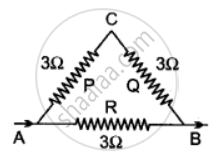
Calculate equivalent resistance in the following cases:
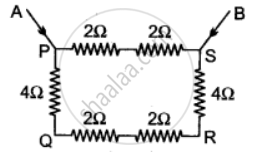
Two resistors when connected in parallel give the resultant resistance of 2 ohms, but when connected in series the effective resistance becomes 9 ohms. Calculate the value of each resistance.
The least resistance obtained by using 2 Ω, 4 Ω, 1 Ω and 100 Ω is:
Three resistors of 6Ω, 4Ω and 4Ω are connected together so that the total resistance is 8Ω. Draw a diagram to show this arrangement and give reason to justify your answer.
Two V-I graphs A and B for series and parallel combinations of two resistors are as shown. Giving reason state which graph shows (a) series, (b) parallel combination of the resistors.

A piece of wire of resistance R is cut into three equal parts. These parts are then connected in parallel. If the equivalent resistance of this parallel combination is R1, what is the value of the ratio R1 : R?
