Advertisements
Advertisements
Question
V1, V2 and V3 are the p.ds. across the 1Ω, 2Ω and 3Ω resistors in the following diagram, and the current is 5 A.
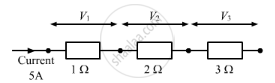
Which one of the columns (a) to (d) shows the correct values of V1, V2 and V3measured in volts?
`V_1` `V_2` `V_3`
(a) 1.0 2.0 3.0
(b) 5.0 10.0 15.0
(c) 5.0 2.5 1.6
(d) 4.0 4.0 2.0
Advertisements
Solution
(b) V1 = 5, V2 = 10 and V3 = 15
Because V = IR, the net voltage can be obtained by multiplying current with resistance.
APPEARS IN
RELATED QUESTIONS
Define the unit of current.
If 20 C of charge pass a point in a circuit in 1 s, what current is flowing?
Which instrument is used to measure electric current? How should it be connected in a circuit?
Consider the circuit given below:
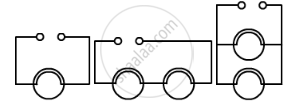
(a) In which circuit are the lamps dimmest?
(b) In which circuit or circuits are the lamps of equal brightness to the lamps in circuit (i)?
(c) Which circuit gives out the maximum light?
An electrician has wired a house in such a way that if a lamp gets fused in one room of the house, all the lamps in other rooms of the house stop working. What is the defect in the wiring?
The lamps in a house hold circuit are connected in parallel because:
(a) this way they required less current
(b) if one lamp fails the others remain lit
(c) this way they require less power
(d) if one lamp fails the other also fail
Consider the circuit given below when A, B and C are three identical light bulbs of constant resistance. 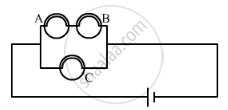
(a) List the bulbs in order of increasing brightness.
(b) If C burns out, what will be the brightness of A now compared with before?
(c) If B burns out instead, what will be the brightness of A and C compared with before?
An electric bulb is rated as 10 W, 220 V. How many of these bulbs can be connected in parallel across the two wires of 220 V supply line if the maximum current which can be drawn is 5 A?
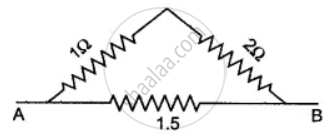
Calculate the effective resistance between the points A and B in the network shown below in Figure 8.45
A bulb marked 12 V, 24 W operates on a 12 volt car battery for 20 minutes. Calculate:
(i) The current flowing through it, and
(ii) The energy liberated.
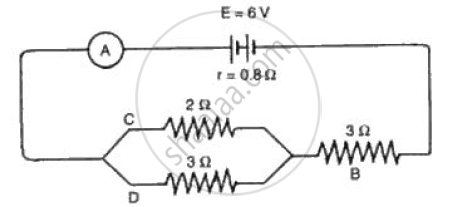
The circuit diagram (Fig.) shows a battery of e.m.f. 6 volts and internal
resistance of 0.8 Ω oonnected in series. Find the
(a) Current reoorded by the ammeter,
(b) P.d. across the terminals of the resistor B,
( c) Current passing through each of the resistors B, C and D, and
( d) P.d. across the terminals of the battery.
Tick (✓) the correct choice among the following :
There are 500 turns and 2000 turns in the primary and secondary coil of a
transformer respectively. If th e output voltage is 1000 V, how large is the
input voltage?
A bulb of 40 W is used for 12.5 h each day for 30 days. Calculate the electrical energy consumed.
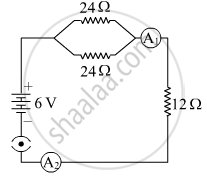
Study the following circuit and find out:
(i) Current in 12 Ω resistor.
(ii) The difference in the readings of A1 and A2, if any.
What is meant by internal resistance of a cell?
Assertion (A): Electric current will not flow between two charged bodies when connected if their charges are the same.
Reason (R): Current is the rate of flow of charge.
Find the odd one out.
Loudspeaker, Bar magnet/magnet, Electric motor, Microphone.
The SI unit of electric current is:
What happens when the switch in a circuit is turned OFF (open circuit)?
