Advertisements
Advertisements
Question
A battery and three lamps are connected as shown:
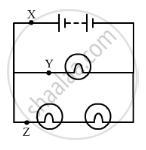
Which of the following statements about the currents at X, Y and Z is correct?
(a) The current at Z is greater than that at Y.
(b) The current at Y is greater than that at Z.
(c) The current at X equals the current at Y.
(d) The current at X equals the current at Z.
Advertisements
Solution
(b) The current at Y is greater than that at Z.
This is so because Y alone will offer less resistance.
APPEARS IN
RELATED QUESTIONS
What actually travels through the wires when you switch on a light?
In which direction do electrons flow?
How many electrons are flowing per second past a point in a circuit in which there is a current of 5 amp?
A p.d. of 6 V is applied to two resistors of 3 Ω and 6 Ω connected in parallel. Calculate:
(a) the combined resistance
(b) the current flowing in the main circuit
(c) the current flowing in the 3 Ω resistor.
What happens to the other bulbs in a series circuit if one bulb blows off?
Which type of circuit, series or parallel, is preferred while connecting a large number of bulbs:
(b) for lighting inside the rooms of the hotel?
Which is the better way to connect lights and other electrical appliances in domestic wiring: series circuits or parallel circuits? why?
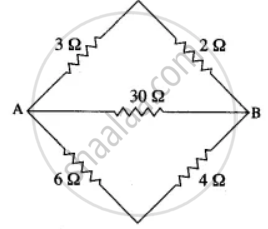
Calculate the equivalent resistance between A and B in the adjacent diagram.
Draw a schematic diagram of an electric circuit consisting of a battery of two cells each of 1.5 V, 5 Ω, 10 Ω and 15 Ω resistors and a plug key, all connected in series.
Define the following:
Super conductors
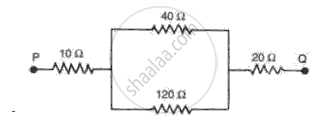
Find the effective resistance in the following circuit diagrams (Fig.):
The following appliances are to be used on 240 V supply. Calculate the current used by each and say which fuse, 2 amp, 5 amp or 13 amp should be incorporated with each, (i) A television rated at 150 W, (ii) An electric iron rated at 750 W, (iii) An immersion heater rated at 3000 W, (iv) A hair dryer rated at 500 W. How much will it cost to run the television set for 100 days for an average of 4 hours a day at 60 paise per unit?
State the condition when it is advantageous to connect cells in series.
What is the SI unit for the current?
1020 electrons, each having a charge of 1.6 x 10⁻¹⁹ C, flows in a circuit V is 0.1s. What is the current in ampere?
The relationship between conventional current and electron flow is that they are:
In semiconductors, the charge carriers are:
Common sources of Direct Current (DC) are:
