Advertisements
Advertisements
Question
State how are the two resistors joined with a battery when equivalent resistance is less than either of the two resistances.
Advertisements
Solution
Parallel
APPEARS IN
RELATED QUESTIONS
Show how would you join three resistors, each of resistance 9 Ω so that the equivalent resistance of the combination is
1) 13.5
2) 6 Ω
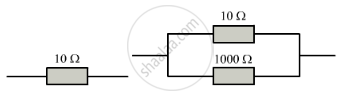
Which of the following arrangement, A or B, has the lower combined resistance?
Two exactly similar electric lamps are arranged (i) in parallel, and (ii) in series. If the parallel and series combination of lamps are connected to 220 V supply line one by one, what will be the ratio of electric power consumed by them?
Calculate the equivalent resistance between the points A and B in Fig. if each resistance is 2·0 Ω.

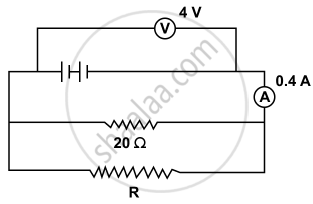
In the following figure calculate:
- the total resistance of the circuit
- the value of R, and
- the current flowing in R.
Solve the following question:
In an electric circuit, two resistors of 12 0 each are joined in parallel to a 6 V battery. Find the current drawn from the battery.
How does the resistance of a metallic wire depend on the thickness of wire?
A given wire is stretched to double its length. How will its resistance change?
Three resistors of 1 Ω, 2 Ω and 3 Ω are connected in parallel. The combined resistance of the three resistors should be:
Two resistors having resistance 8 Ω and 12 Ω are connected in parallel. Find their equivalent resistance.
