Advertisements
Advertisements
Question
Show how would you connect three resistors, each of resistance 6 O so that
the combination has a resistance of(a) 9 Ω (b) 4 .Ω
Advertisements
Solution
(a) To get an equivalent resistance of 9Ω using three 6 Ω resistors, they should be connected in parallel as shown:

Between A and C, the equivalent resistance is
`1/"R"_"parallel" = 1/6 + 1/6 = 2/6 = 1/3 Ω`
`"R"_"parallel" = 3 Ω
Between A and B, the equivalent resistance is
`"R"_"series" = 3 + 6 = 9Ω
(b) To get an equivalent resistance of 4 Ω using three 6 Ω resistors, they should be connected in parallel as shown:
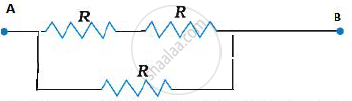
Between A and B, the series combination of two 6 Ω resistors is connected in parallel with the third 6Ω resistor.
`"R"_"series" = 6 + 6 = 12Ω`
`1/"R"_"equivalent" = 1/6 + 1/12 = 3/12 = 1/4 Ω`
RELATED QUESTIONS
Show how you would connect three resistors, each of resistance 6 Ω, so that the combination has a resistance of 9 Ω.
Several electric bulbs designed to be used on a 220 V electric supply line are rated 10 W. How many lamps can be connected in parallel with each other across the two wires of 220 V line if the maximum allowable current is 5 A?
How will you connect three resistors of resistances 2 Ω, 3 Ω, and 6 Ω to obtain a total resistance of 4 Ω, and 1 Ω?
In parallel combination of resistances ______.
Calculate the equivalent resistance between the points A and B in Fig. if each resistance is 2·0 Ω.

A particular resistance wire has a resistance of 3 ohm per meter. Find :
The total resistance of three lengths of this wire each 1.5 m long, in parallel.
How does the resistance of a metallic wire depend on the thickness of wire?
What connection is used in domestic appliances and why?
Two resistors having resistance 8 Ω and 12 Ω are connected in parallel. Find their equivalent resistance.
A particular resistance wire has a resistance of 3·0 ohm per metre. Find the resistance of 5 m length of a wire of the same material, but with twice the area of cross section.
