Advertisements
Advertisements
प्रश्न
Show how would you connect three resistors, each of resistance 6 O so that
the combination has a resistance of(a) 9 Ω (b) 4 .Ω
Advertisements
उत्तर
(a) To get an equivalent resistance of 9Ω using three 6 Ω resistors, they should be connected in parallel as shown:

Between A and C, the equivalent resistance is
`1/"R"_"parallel" = 1/6 + 1/6 = 2/6 = 1/3 Ω`
`"R"_"parallel" = 3 Ω
Between A and B, the equivalent resistance is
`"R"_"series" = 3 + 6 = 9Ω
(b) To get an equivalent resistance of 4 Ω using three 6 Ω resistors, they should be connected in parallel as shown:
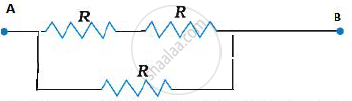
Between A and B, the series combination of two 6 Ω resistors is connected in parallel with the third 6Ω resistor.
`"R"_"series" = 6 + 6 = 12Ω`
`1/"R"_"equivalent" = 1/6 + 1/12 = 3/12 = 1/4 Ω`
संबंधित प्रश्न
Several electric bulbs designed to be used on a 220 V electric supply line are rated 10 W. How many lamps can be connected in parallel with each other across the two wires of 220 V line if the maximum allowable current is 5 A?
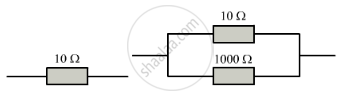
Which of the following arrangement, A or B, has the lower combined resistance?
Explain with the help of a labelled circuit diagram, how you will find the resistance of a combination of three resistors of resistances R1, R2 and R3 joined in parallel.
The figure given below shows three resistors?
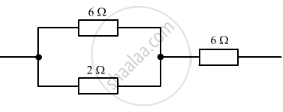
Their combined resistance is:
(a) `1 5/7`Ω
(b) `14` Ω
(c) `6 2/3` Ω
(d) `7 1/2` Ω
Four resistors each of resistance 2Ω are connected in parallel. What is the effective resistance?
Calculate the equivalent resistance between the points A and B in Fig. if each resistance is 2·0 Ω.

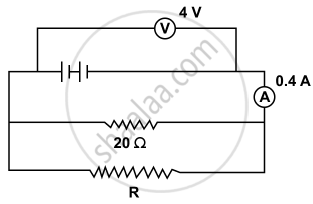
In the following figure calculate:
- the total resistance of the circuit
- the value of R, and
- the current flowing in R.
Two resistors having resistance 8 Ω and 12 Ω are connected in parallel. Find their equivalent resistance.
Two resistors of resistance 2 Ω and 3 Ω are connected in parallel to a cell to draw current 0.5 A from the cell. Calculate the current in each resistor.
