Advertisements
Advertisements
प्रश्न
A piece of wire of resistance R is cut into three equal parts. These parts are then connected in parallel. If the equivalent resistance of this parallel combination is R1, what is the value of the ratio R1 : R?
Advertisements
उत्तर १
The resistance of each part is `"R"/3` Ω (as resistance is proportional to the length of the wire.)
`1/"R"_1 = 3/"R" + 3/"R" + 3/"R"`
`1/"R"_1= (3 + 3 + 3)/"R"`
`1/"R"_1= 9/"R"`
∴ `"R"_1 = "R"/9`
∴ `"R"_1/"R" = 1/9`
उत्तर २
The resistance of each part is `"R"/3` Ω (as resistance is proportional to the length of the wire.)
`1/"R"_1 = 3/"R" + 3/"R" + 3/"R"`
`1/"R"_1= (3 + 3 + 3)/"R"`
`1/"R"_1= 9/"R"`
∴ `1/"R"_1 = 9/"R"`
∴ `"R"/"R"_1 = 9`
APPEARS IN
संबंधित प्रश्न
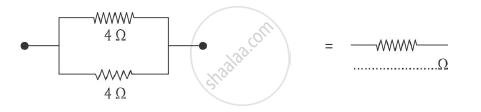
Complete the following :-
(b)
Two resistances when connected in parallel give resultant value of 2 ohm; when connected in series the value becomes 9 ohm. Calculate the value of each resistance.
State how are the two resistors joined with a battery when equivalent resistance is less than either of the two resistances.
A uniform wire with a resistance of 27 Ω is divided into three equal pieces and then they are joined in parallel. Find the equivalent resistance of the parallel combination.
Explain, why is the p.d. between the terminals of a storage battery less when it is supplying current than when it is on open circuit. A battery of e.m.f. 10 volts and internal resistance 2.5 ohms has two resistances of 50 ohms each connected to it. Calculate the power dissipated in each resistance
(a) When they are in series,
(b) When they are in parallel.
In each case calculate the power dissipated in the battery.
Tick (✓) the correct choice among the following :
Consider two cases of two parallel current carrying conductors. Current in
th e same direction and currents in th e opposi te directions will produce
A current of 2 A is passed through a coil of resistance 75 Ω for 2 minutes.
(a) How much heat energy is produced?
(b) How much charge is passed through the resistance?
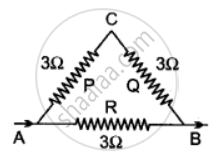
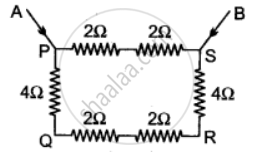
Calculate equivalent resistance in the following cases:
A coil in the heater consumes power P on passing current. If it is cut into halves and joined in parallel, it will consume power:
