Advertisements
Advertisements
प्रश्न
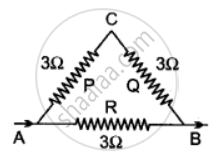
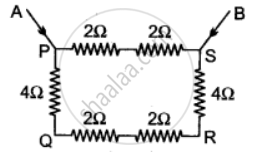
Calculate equivalent resistance in the following cases:
Advertisements
उत्तर
(i) Resistance P and Q are in series = 3 Ω + 3 Ω = 6 Ω
Resistance of 6 Ω segment and 3 Ω are parallel.
∴ `1/"R" = 1/6 + 1/3 = (1 + 2)/6 = 3/6` or R = 2Ω
(ii) Resistance of the arm PS = 2Ω +2Ω = 4Ω (in series)
Resistance of the arm QR = 2Ω + 2Ω = 4Ω (in series)
Resistance of the arm PQ, QR and RS are in series
= (4 + 4 + 4)Ω = 12Ω
Now resistance of the arm RS and arms (PQ + QR + RS) are in parallel.
`1/"R" = 1/4 + 1/12`
`= (3 + 1)/12 = 4/12`
or R = 3Ω
संबंधित प्रश्न
How can three resistors of resistances 2 Ω, 3 Ω and 6 Ω be connected to give a total resistance of 4 Ω ?
Show how you would connect three resistors, each of resistance 6 Ω, so that the combination has a resistance of 9 Ω.
State the law of combination of resistances in parallel.
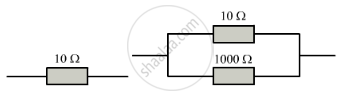
Which of the following arrangement, A or B, has the lower combined resistance?
A wire of resistance R1 is cut into five equal pieces. These five pieces of wire are then connected in parallel. If the resultant resistance of this combination be R2, then the ratio `R_1/R_2` is:
(a) `1/25`
(b)1/5
(c)5
(c)25
State how are the two resistors joined with a battery when potential difference is same across each resistor.
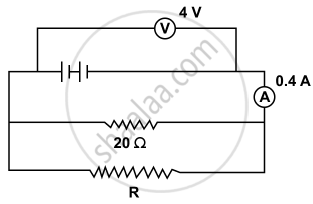
In the following figure calculate:
- the total resistance of the circuit
- the value of R, and
- the current flowing in R.
Solve the following question:
In an electric circuit, two resistors of 12 0 each are joined in parallel to a 6 V battery. Find the current drawn from the battery.
A given wire is stretched to double its length. How will its resistance change?
Two devices are connected between two points say A and B in parallel. The physical quantity that will remain the same between the two points is:
