Advertisements
Advertisements
प्रश्न
A particular resistance wire has a resistance of 3 ohm per meter. Find the total resistance of three lengths of this wire each 1.5 m long, joined in parallel.
Advertisements
उत्तर
Resistance of 1 m of wire = 3 ohm
Resistance of 1.5 m of wire = 3 × 1.5 = 4.5 Ω
`1/R=1/4.5+1/4.5+1/4.5=3/4.5`
R = 1.5 Ω
APPEARS IN
संबंधित प्रश्न
What are the advantages of connecting electrical devices in parallel with the battery instead of connecting them in series?
A hot plate of an electric oven connected to a 220 V line has two resistance coils A and B, each of 24 Ω resistances, which may be used separately, in series, or in parallel. What are the currents in the three cases?
Show how would you join three resistors, each of resistance 9 Ω so that the equivalent resistance of the combination is
1) 13.5
2) 6 Ω
The figure given below shows three resistors?
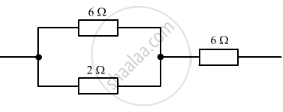
Their combined resistance is:
(a) `1 5/7`Ω
(b) `14` Ω
(c) `6 2/3` Ω
(d) `7 1/2` Ω
Show with the help of diagrams, how you would connect three resistors each of resistance 6 Ω, so that the combination has resistance of (i) 9 Ω (ii) 4 Ω.
You are given three resistances of 1, 2 and 3 ohms. Shows by diagrams, how with the help of these resistances you can get:
(i) 6 Ω
(ii) `6/1` Ω
(iii) 1.5 Ω
A uniform wire with a resistance of 27 Ω is divided into three equal pieces and then they are joined in parallel. Find the equivalent resistance of the parallel combination.
Tick (✓) the correct choice among the following :
Consider two cases of two parallel current carrying conductors. Current in
th e same direction and currents in th e opposi te directions will produce
What connection is used in domestic appliances and why?
Four resistors each of resistance 5 Ω are connected in parallel. What is the effective resistance?
