Advertisements
Advertisements
प्रश्न
A battery of e.m.f. 15 V and internal resistance 2 `Omega` is connected to tvvo resistors of 4 ohm and 6 ohm joined.
(i) In series,
(ii) In para 1 lel. Find in each case the electrica I energy spent per minute in 6 ohm resistor.
Advertisements
उत्तर
Given, emf= 15 V, internal resistance, r= 2 `Omega`
(i) Total resistance of given resistors in series, Rs = 4 + 6 = 10 `Omega`
Now, current through series combination on, Is = `"emf"/("R"_"s" + "r") = 15/(10 + 2) = 15/12` = 1.25 A
In series, the same current will pass through each resistor
.·. electrical energy spent per minute in the 6`Omega` resistor, Hs = I2 (R) t = (1.25)2 (6) (60) = 562.5 J
(ii) Total resistance of given resistors in parallel, RP = `(1/4 + 1/6) ^-1 = 2.4 Omega`
Current in parallel circuit, I = `15/(2.4 + 20) = 3.4 "A"`
In parallel, each resistor is connected across the same voltage, say V.
Then, V = e - Ir= 15 - (3.4 x 2) = 8.18 volt
:. electrical energy spent per minute in the 6Ω resistor, Hp = `"V"^2/"R" t = (8.18)^2/6 xx 60 `= 669.1 J
APPEARS IN
संबंधित प्रश्न
How can three resistors of resistances 2 Ω, 3 Ω and 6 Ω be connected to give a total resistance of 4 Ω ?
Explain with diagram what is meant by the "series combination" and "parallel combination" of resistances. In which case the resultant resistance is : (i) less, and (ii) more, than either of the individual resistances?
In the circuit given below:
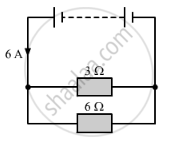
(a) What is the combined resistance?
(b) What is the p.d. across the combined resistor?
(c) What is the p.d. across the 3 Ω resistor?
(d) What is the current in the 3 Ω resistor?
(e) What is the current in the 6 Ω resistor?
Two resistors having resistance 4𝛀 and 6𝛀 are connected in parallel. Find their equivalent resistance.
What is the equivalent resistance of 5 equal resistors, each of value 2`Omega` 1 when oonnected in (a) Series ( b) ParaIleI?
Show how would you connect three resistors, each of resistance 6 O so that
the combination has a resistance of(a) 9 Ω (b) 4 .Ω
Tick (✓) the correct choice among the following :
Consider two cases of two parallel current carrying conductors. Current in
th e same direction and currents in th e opposi te directions will produce
How does the resistance of a metallic wire depend on the thickness of wire?
Calculate the current flows through the 10 Ω resistor in the following circuit.

A particular resistance wire has a resistance of 3·0 ohm per metre. Find the resistance of 5 m length of a wire of the same material, but with twice the area of cross section.
