Advertisements
Advertisements
प्रश्न
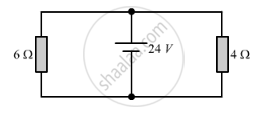
Find the current in each resistor in the circuit shown below:
Advertisements
उत्तर
In the given circuit, two 6 Ω and 4 Ω resistors are connected in parallel combination across a cell of 24 V. We know that in a parallel combination, the voltage across the resistor remains the same and only the current gets divided. So the current (I1) through the 6 Ω resistor is:
`I_1=V/R_1`
here R_1=6Ω
V=24V
so
`I_1=24/6`
`or I_1=4A
`The current (l_2) through the 4 resistors is :`
`I_2=V/R_2`
R_2=4Ω
`I=24/4`
`or I=6A`
APPEARS IN
संबंधित प्रश्न
The equivalent resistance of the parallel combination of two resistors of 60Ω and 40Ω is _______.
A) 24Ω
(B) 100Ω
(C) 50 Ω
(D) 240Ω
Show how would you join three resistors, each of resistance 9 Ω so that the equivalent resistance of the combination is
1) 13.5
2) 6 Ω
Two resistors, with resistance 5 Ω and 10 Ω respectively are to be connected to a battery of emf 6 V so as to obtain:
(i) minimum current flowing
(ii) maximum current flowing
(a) How will you connect the resistances in each case?
(b) Calculate the strength of the total current in the circuit in the two cases.
In the circuit given below:
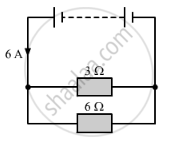
(a) What is the combined resistance?
(b) What is the p.d. across the combined resistor?
(c) What is the p.d. across the 3 Ω resistor?
(d) What is the current in the 3 Ω resistor?
(e) What is the current in the 6 Ω resistor?
In the diagram shown alongside, the cell and the ammeter both have negligible resistance. The resistors are identical.
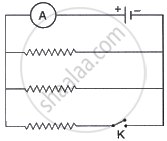
With the switch K open, the ammeter reads 0.6 A. What will be the ammeter reading when the switch is closed?
State how are the two resistors joined with a battery when equivalent resistance is less than either of the two resistances.
Calculate the equivalent resistance between the points A and B in Fig. if each resistance is 2·0 Ω.

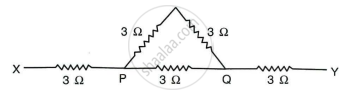
Five resistors, each 3 Ω, are connected as shown in Fig. Calculate the resistance
- between the points P and Q.
- between the points X and Y.
A battery of e.m.f 16 V and internal resistance 2 Ω is connected to two resistors 3Ω and 6Ω connected in parallel. Find:
- the current through the battery.
- p.d. between the terminals of the battery,
- the current in 3 Ω resistors,
- the current in 6 Ω resistor.
What are the advantages of a parallel connection?
Two resistors of resistance 4 Ω and 6 Ω are connected in parallel to a cell to draw 0.5 A current from the cell.
Draw a labeled diagram of the arrangement
Two resistors of resistance 4 Ω and 6 Ω are connected in parallel to a cell to draw 0.5 A current from the cell.
Calculate current in each resistor.
An electrical appliance has a rating 100 W, 120V. The resistance of element of appliance when in use:
A current of 2 A is passed through a coil of resistance 75 Ω for 2 minutes.
(a) How much heat energy is produced?
(b) How much charge is passed through the resistance?
The equivalent resistance of a parallel combination of two resistors of 30 Ω and 60 Ω is ______________.
How does the resistance of a metallic wire depend on the thickness of wire?
Two devices are connected between two points say A and B in parallel. The physical quantity that will remain the same between the two points is:
A piece of wire of resistance R is cut into three equal parts. These parts are then connected in parallel. If the equivalent resistance of this parallel combination is R1, what is the value of the ratio R1 : R?
