Advertisements
Advertisements
प्रश्न
How does the resistance of a metallic wire depend on the thickness of wire?
Advertisements
उत्तर
The resistance of a wire decreases with increase in its thickness (R ∝ l/a where a = πr2, the area of cross-section of the wire).
संबंधित प्रश्न
What are the advantages of connecting electrical devices in parallel with the battery instead of connecting them in series?
A hot plate of an electric oven connected to a 220 V line has two resistance coils A and B, each of 24 Ω resistances, which may be used separately, in series, or in parallel. What are the currents in the three cases?
Two resistors, with resistance 5 Ω and 10 Ω respectively are to be connected to a battery of emf 6 V so as to obtain:
(i) minimum current flowing
(ii) maximum current flowing
(a) How will you connect the resistances in each case?
(b) Calculate the strength of the total current in the circuit in the two cases.
How will you connect three resistors of 2 Ω, 3 Ω and 5 Ω respectively so as to obtain a resultant of 2.5 Ω? Draw the diagram to show the arrangement.
Which of the following combinations have the same equivalent resistance between X and Y?
A combination consists of three resistors in series. Four similar sets are connected in parallel. If the resistance of each resistor is 2 ohm, find the resistance of the combination.
What are the advantages of a parallel connection?
Tick (✓) the correct choice among the following :
Consider two cases of two parallel current carrying conductors. Current in
th e same direction and currents in th e opposi te directions will produce
The circuit diagram Fig shows three resistors 2 Ω, 4 Ω and R Ω connected to a battery of e.m.f. 2 V and internal resistance 3 Ω. If main current of 0.25 A flows through the circuit, find:
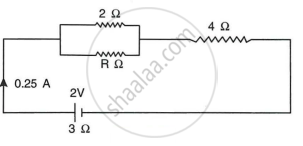
- the p.d. across the 4 Ω resistor,
- the p.d. across the internal resistance of the cell,
- the p.d. across the R Ω or 2 Ω resistors
- the value of R.
The equivalent resistance of a parallel combination of two resistors of 30 Ω and 60 Ω is ______________.
