Advertisements
Advertisements
Question
What are the advantages of connecting electrical devices in parallel with the battery instead of connecting them in series?
Advertisements
Solution
There is no division of voltage among the appliances when connected in parallel. The potential difference across each appliance is equal to the supplied voltage. The total effective resistance of the circuit can be reduced by connecting electrical appliances in parallel.
APPEARS IN
RELATED QUESTIONS
With a neat labelled diagram and derive the equation for three resistances connected in parallel.
How many 176 Ω resistors (in parallel) are required to carry 5 A on a 220 V line?
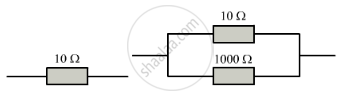
Which of the following arrangement, A or B, has the lower combined resistance?
A 4 Ω coil and a 2 Ω coil are connected in parallel. What is their combined resistance? A total current of 3 A passes through the coils. What current passes through the 2 Ω coil?
A wire of resistance R1 is cut into five equal pieces. These five pieces of wire are then connected in parallel. If the resultant resistance of this combination be R2, then the ratio `R_1/R_2` is:
(a) `1/25`
(b)1/5
(c)5
(c)25
Two resistances when connected in parallel give resultant value of 2 ohm; when connected in series the value becomes 9 ohm. Calculate the value of each resistance.
In parallel combination of resistances ______.
Four resistors each of resistance 2Ω are connected in parallel. What is the effective resistance?
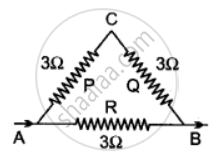
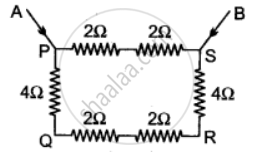
Calculate the equivalent resistance between the points A and B in Fig. if each resistance is 2·0 Ω.

The circuit diagram Fig shows three resistors 2 Ω, 4 Ω and R Ω connected to a battery of e.m.f. 2 V and internal resistance 3 Ω. If main current of 0.25 A flows through the circuit, find:
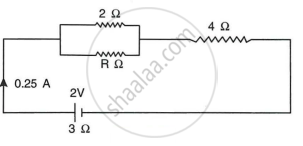
- the p.d. across the 4 Ω resistor,
- the p.d. across the internal resistance of the cell,
- the p.d. across the R Ω or 2 Ω resistors
- the value of R.
Two resistors of resistance 4 Ω and 6 Ω are connected in parallel to a cell to draw 0.5 A current from the cell.
Draw a labeled diagram of the arrangement
How does the resistance of a metallic wire depend on the length of wire?
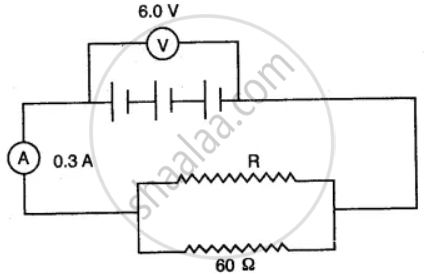
In the figure below, the ammeter A reads 0.3 A. Calculate:
(i) the total resistance of the circuit
(ii) the value of R
(iii) the current flowing through R.
Calculate equivalent resistance in the following cases:
Two devices are connected between two points say A and B in parallel. The physical quantity that will remain the same between the two points is:
Assertion: When a battery is short circuited, the terminal voltage is zero.
Reason: In a short circuit, the current is zero.
Two resistors of resistance 2 Ω and 3 Ω are connected in parallel to a cell to draw current 0.5 A from the cell. Calculate the current in each resistor.
