Advertisements
Advertisements
Question
A battery of e.m.f 16 V and internal resistance 2 Ω is connected to two resistors 3Ω and 6Ω connected in parallel. Find:
- the current through the battery.
- p.d. between the terminals of the battery,
- the current in 3 Ω resistors,
- the current in 6 Ω resistor.
Advertisements
Solution
E.m.f. of battery E = 16V, r = 2Ω
Effective resistance of 3Ω and 6Ω connected in parallel R is
`1/"R" = 1/3 + 1/6`
= `3/6`
= `1/2`
∴ R = 2Ω
Total resistance = (R + r)
= (2 +2)
= 4Ω
(a) Current through battery
I = `"V"/("R" + r) = "E"/("R" +r)`
I = `(16V)/(4Ω)`
= 4 A
(b) p.d between terminal of battery
V = IR
= 4 × 2
= 8V
(c) The current in 3Ω resistor
I1 = `"V"/"R"`
= `8/3`
= 2.66 A
(d) The current in 6Ω resistor
I2 = `"V"/"R"`
= `8/6`
= 1.34 A
APPEARS IN
RELATED QUESTIONS
An electric lamp of 100 Ω, a toaster of resistance 50 Ω, and a water filter of resistance 500 Ω are connected in parallel to a 220 V source. What is the resistance of an electric iron connected to the same source that takes as much current as all three appliances, and what is the current through it?
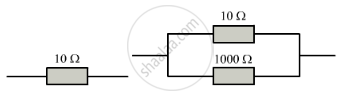
Which of the following arrangement, A or B, has the lower combined resistance?
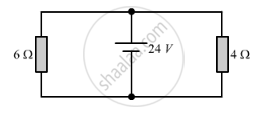
Find the current in each resistor in the circuit shown below:
Two exactly similar electric lamps are arranged (i) in parallel, and (ii) in series. If the parallel and series combination of lamps are connected to 220 V supply line one by one, what will be the ratio of electric power consumed by them?
Calculate the equivalent resistance between the points A and B in Fig. if each resistance is 2·0 Ω.

A particular resistance wire has a resistance of 3 ohm per meter. Find the total resistance of three lengths of this wire each 1.5 m long, joined in parallel.
A particular resistance wire has a resistance of 3 ohm per meter. Find the potential difference of the battery which gives a current of 2 A in each of the 1.5 m length when connected in the parallel to the battery (assume that resistance of the battery is negligible).
A coil in the heater consumes power P on passing current. If it is cut into halves and joined in parallel, it will consume power:
A piece of wire of resistance R is cut into three equal parts. These parts are then connected in parallel. If the equivalent resistance of this parallel combination is R1, what is the value of the ratio R1 : R?
A particular resistance wire has a resistance of 3·0 ohm per metre. Find the resistance of 5 m length of a wire of the same material, but with twice the area of cross section.
