Advertisements
Advertisements
Question
What is the equivalent resistance of 5 equal resistors, each of value 2`Omega` 1 when oonnected in (a) Series ( b) ParaIleI?
Advertisements
Solution
(a) In series:
Equivalent series resistance, Rs = 2 + 2 + 2 + 2 + 2 = 10 `Omega`
(b) In parallel
Equivalent parallel resistance RP = `("Resistance of each resistor"/"No. of Resistors") = 2/5 Omega`
APPEARS IN
RELATED QUESTIONS
What are the advantages of connecting electrical devices in parallel with the battery instead of connecting them in series?
The equivalent resistance of the parallel combination of two resistors of 60Ω and 40Ω is _______.
A) 24Ω
(B) 100Ω
(C) 50 Ω
(D) 240Ω
State the law of combination of resistances in parallel.
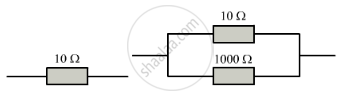
Which of the following arrangement, A or B, has the lower combined resistance?
Two resistances when connected in parallel give resultant value of 2 ohm; when connected in series the value becomes 9 ohm. Calculate the value of each resistance.
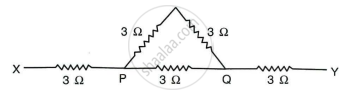
Five resistors, each 3 Ω, are connected as shown in Fig. Calculate the resistance
- between the points P and Q.
- between the points X and Y.
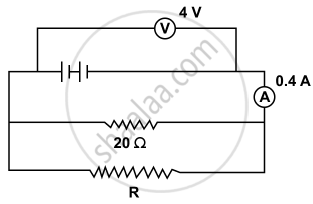
In the following figure calculate:
- the total resistance of the circuit
- the value of R, and
- the current flowing in R.
A particular resistance wire has a resistance of 3 ohm per meter. Find the total resistance of three lengths of this wire each 1.5 m long, joined in parallel.
The least resistance obtained by using 2 Ω, 4 Ω, 1 Ω and 100 Ω is:
Two resistors of resistances 2 Ω and 3 Ω are connected in parallel to a cell to draw current 0.5 A from the cell. Draw a labelled diagram of the arrangement
