Advertisements
Advertisements
Question
Tick (✓) the correct choice among the following :
Consider two cases of two parallel current carrying conductors. Current in
th e same direction and currents in th e opposi te directions will produce
Options
Attraction and repulsion respectively
Repulsion and attraction respectively,
Attraction in both cases
Repulsion in both cases
Osci llation in both cases
Advertisements
Solution
Repulsion and attraction respectively,
APPEARS IN
RELATED QUESTIONS
With a neat labelled diagram and derive the equation for three resistances connected in parallel.
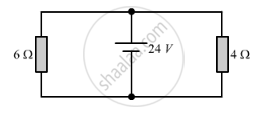
Find the current in each resistor in the circuit shown below:
In the circuit given below:
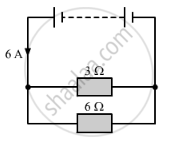
(a) What is the combined resistance?
(b) What is the p.d. across the combined resistor?
(c) What is the p.d. across the 3 Ω resistor?
(d) What is the current in the 3 Ω resistor?
(e) What is the current in the 6 Ω resistor?
A battery of e.m.f 16 V and internal resistance 2 Ω is connected to two resistors 3Ω and 6Ω connected in parallel. Find:
- the current through the battery.
- p.d. between the terminals of the battery,
- the current in 3 Ω resistors,
- the current in 6 Ω resistor.
Two devices are connected between two points say A and B in parallel. The physical quantity that will remain the same between the two points is:
The least resistance obtained by using 2 Ω, 4 Ω, 1 Ω and 100 Ω is:
A coil in the heater consumes power P on passing current. If it is cut into halves and joined in parallel, it will consume power:
Two V-I graphs A and B for series and parallel combinations of two resistors are as shown. Giving reason state which graph shows (a) series, (b) parallel combination of the resistors.

Four resistors each of resistance 5 Ω are connected in parallel. What is the effective resistance?
A particular resistance wire has a resistance of 3·0 ohm per metre. Find the resistance of 5 m length of a wire of the same material, but with twice the area of cross section.
