Advertisements
Advertisements
Question
Complete the following :-
(c)

Advertisements
Solution
(c)
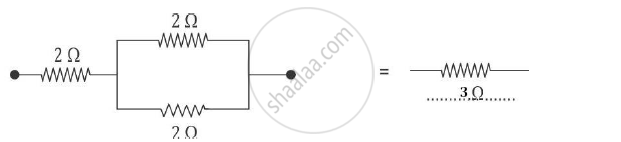
`"The equivalent resistance is "R_(eq)=2+(1/2+1/2)=2+2/2=2+1=3Omega`
APPEARS IN
RELATED QUESTIONS
Differentiate between resistances in series and parallel.
How can three resistors of resistances 2 Ω, 3 Ω and 6 Ω be connected to give a total resistance of 4 Ω ?
How many 176 Ω resistors (in parallel) are required to carry 5 A on a 220 V line?
Show how you would connect two 4 ohm resistors to produce a combined resistance of (a) 2 ohms (b) 8 ohms.
A wire that has resistance R is cut into two equal pieces. The two parts are joined in parallel. What is the resistance of the combination?
Find the current in each resistor in the circuit shown below:
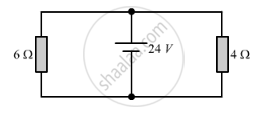
In the circuit given below:
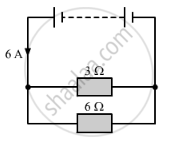
(a) What is the combined resistance?
(b) What is the p.d. across the combined resistor?
(c) What is the p.d. across the 3 Ω resistor?
(d) What is the current in the 3 Ω resistor?
(e) What is the current in the 6 Ω resistor?
A 4 Ω coil and a 2 Ω coil are connected in parallel. What is their combined resistance? A total current of 3 A passes through the coils. What current passes through the 2 Ω coil?
The figure given below shows three resistors?
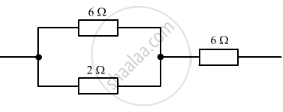
Their combined resistance is:
(a) `1 5/7`Ω
(b) `14` Ω
(c) `6 2/3` Ω
(d) `7 1/2` Ω
You are given three resistances of 1, 2 and 3 ohms. Shows by diagrams, how with the help of these resistances you can get:
(i) 6 Ω
(ii) `6/1` Ω
(iii) 1.5 Ω
How will you connect three resistors of 2 Ω, 3 Ω and 5 Ω respectively so as to obtain a resultant of 2.5 Ω? Draw the diagram to show the arrangement.
Two resistors having resistance 4𝛀 and 6𝛀 are connected in parallel. Find their equivalent resistance.
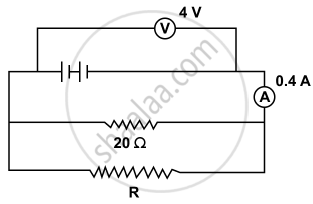
In the following figure calculate:
- the total resistance of the circuit
- the value of R, and
- the current flowing in R.
A given wire is stretched to double its length. How will its resistance change?
What connection is used in domestic appliances and why?
Two resistors when connected in parallel give the resultant resistance of 2 ohms, but when connected in series the effective resistance becomes 9 ohms. Calculate the value of each resistance.
Three resistors of 1 Ω, 2 Ω and 3 Ω are connected in parallel. The combined resistance of the three resistors should be:
Assertion: When a battery is short circuited, the terminal voltage is zero.
Reason: In a short circuit, the current is zero.
Three resistors of 6Ω, 4Ω and 4Ω are connected together so that the total resistance is 8Ω. Draw a diagram to show this arrangement and give reason to justify your answer.
Study the following circuit:

On the basis of this circuit, answer the following questions:
i. Find the value of total resistance between the points A and B.
ii. Find the resistance between the points B and C.
iii. Calculate the current drawn from the battery, when the key is closed
OR
iii. In the above circuit, the 16Ω resistor or the parallel combination of two resistors of 8 Ω, which one of the two will have more potential difference across its two ends? Justify your answer.
