Advertisements
Advertisements
Question
How many 176 Ω resistors (in parallel) are required to carry 5 A on a 220 V line?
Advertisements
Solution
Suppose n resistors of resistance 176 Ω are connected in parallel.
Therefore, the value of equivalent resistance (Rp) will be:
`1/"R"_"p" = 1/176 + 1/176 + ... + "n"`
`1/"R"_"p" = "n". (1/176)`
Rp = `176/"n"` Ω ......(1)
Given, V = 220 V and I = 5 A
∴ According to Ohm's law: Rp = `"V"/"I"`
= `220/5`
= 44 Ω
By substituting the value of Rp in equation (1), we get:
44 = `176/"n"`
n = `176/44`
n = 4
Hence, the number of resistors (n) is 4.
APPEARS IN
RELATED QUESTIONS
With a neat labelled diagram and derive the equation for three resistances connected in parallel.
The equivalent resistance of the parallel combination of two resistors of 60Ω and 40Ω is _______.
A) 24Ω
(B) 100Ω
(C) 50 Ω
(D) 240Ω
An electric heater which is connected to a 220 V supply line has two resistance coils A and B of 24 Ω resistance each. These coils can be used separately (one at a time), in series or in parallel. Calculate the current drawn when:
(a) only one coil A is used.
(b) coils A and B are used in series.
(c) coils A and B are uses in parallel.
In the diagram shown alongside, the cell and the ammeter both have negligible resistance. The resistors are identical.
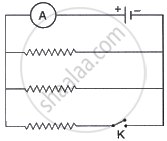
With the switch K open, the ammeter reads 0.6 A. What will be the ammeter reading when the switch is closed?
A wire of resistance R1 is cut into five equal pieces. These five pieces of wire are then connected in parallel. If the resultant resistance of this combination be R2, then the ratio `R_1/R_2` is:
(a) `1/25`
(b)1/5
(c)5
(c)25
How will you connect three resistors of 2 Ω, 3 Ω and 5 Ω respectively so as to obtain a resultant of 2.5 Ω? Draw the diagram to show the arrangement.
A particular resistance wire has a resistance of 3 ohm per meter. Find the potential difference of the battery which gives a current of 2 A in each of the 1.5 m length when connected in the parallel to the battery (assume that resistance of the battery is negligible).
A current of 2 A is passed through a coil of resistance 75 Ω for 2 minutes.
(a) How much heat energy is produced?
(b) How much charge is passed through the resistance?
The equivalent resistance of a parallel combination of two resistors of 30 Ω and 60 Ω is ______________.
Solve the following question:
In an electric circuit, two resistors of 12 0 each are joined in parallel to a 6 V battery. Find the current drawn from the battery.
State the S.I. unit of electrical resistance and define it.
How does the resistance of a metallic wire depend on the length of wire?
A piece of wire having a resistance R is cut into five equal parts.
- How will the resistance of each part of the wire change compared with the original resistance?
- If the five parts of the wire are placed in parallel, how will the resistance of the combination change?
- What will be ratio of the effective resistance in series connection to that of the parallel connection?
Calculate the current flows through the 10 Ω resistor in the following circuit.

A coil in the heater consumes power P on passing current. If it is cut into halves and joined in parallel, it will consume power:
Three resistors of 1 Ω, 2 Ω and 3 Ω are connected in parallel. The combined resistance of the three resistors should be:
Two V-I graphs A and B for series and parallel combinations of two resistors are as shown. Giving reason state which graph shows (a) series, (b) parallel combination of the resistors.

Study the following circuit:

On the basis of this circuit, answer the following questions:
i. Find the value of total resistance between the points A and B.
ii. Find the resistance between the points B and C.
iii. Calculate the current drawn from the battery, when the key is closed
OR
iii. In the above circuit, the 16Ω resistor or the parallel combination of two resistors of 8 Ω, which one of the two will have more potential difference across its two ends? Justify your answer.
Four resistors each of resistance 5 Ω are connected in parallel. What is the effective resistance?
A particular resistance wire has a resistance of 3·0 ohm per metre. Find the resistance of 5 m length of a wire of the same material, but with twice the area of cross section.
