Advertisements
Advertisements
Question
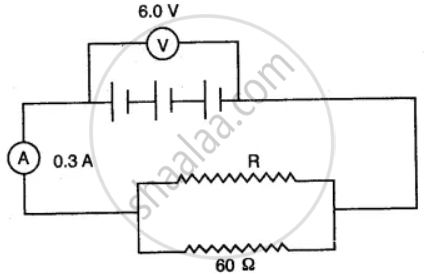
In the figure below, the ammeter A reads 0.3 A. Calculate:
(i) the total resistance of the circuit
(ii) the value of R
(iii) the current flowing through R.
Advertisements
Solution
(i) ∵ V = IR
∴ R = `"V"/"I" = 6.0/0.3 = 20 Ω`
(ii) Total resistance = 20 Ω
∵ Resistance in parallel
∴ `1/20 = 1/"R" + 1/60`
`1/"R" = 1/20 - 1/60`
`1/"R" = (3 - 1)/60`
R = `60/2 = 30 `Ω
(iii) ∵ V = IR
and potential (V) is equal at the two ends i.e. A and B
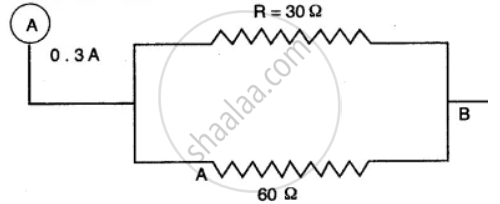
Let I1 be current flowing through R
∴ (0.3 - I1) is current flowing through 60 Ω resistance.
Now V = V ⇒ I1R1 = I2R2
I1 × 30 = (0.3 - I1) × 60
I1 = 0.6 - 2I1
3I1 = 0.6
I1 = `0.6/3 = 0.2`
∴ Current flowing through R = 0.2 A
RELATED QUESTIONS
Differentiate between resistances in series and parallel.
An electric heater which is connected to a 220 V supply line has two resistance coils A and B of 24 Ω resistance each. These coils can be used separately (one at a time), in series or in parallel. Calculate the current drawn when:
(a) only one coil A is used.
(b) coils A and B are used in series.
(c) coils A and B are uses in parallel.
In the circuit given below:
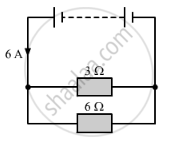
(a) What is the combined resistance?
(b) What is the p.d. across the combined resistor?
(c) What is the p.d. across the 3 Ω resistor?
(d) What is the current in the 3 Ω resistor?
(e) What is the current in the 6 Ω resistor?
State how are the two resistors joined with a battery when potential difference is same across each resistor.
A given wire is stretched to double its length. How will its resistance change?
A coil in the heater consumes power P on passing current. If it is cut into halves and joined in parallel, it will consume power:
Assertion: When a battery is short circuited, the terminal voltage is zero.
Reason: In a short circuit, the current is zero.
Three resistors of 6Ω, 4Ω and 4Ω are connected together so that the total resistance is 8Ω. Draw a diagram to show this arrangement and give reason to justify your answer.
Two V-I graphs A and B for series and parallel combinations of two resistors are as shown. Giving reason state which graph shows (a) series, (b) parallel combination of the resistors.

Four resistors each of resistance 5 Ω are connected in parallel. What is the effective resistance?
