Advertisements
Advertisements
Question
A battery of 9 V is connected in series with resistors of 0.2 Ω, 0.3 Ω, 0.4 Ω, 0.5 Ω and 12 Ω. How much current would flow through the 12 Ω resistor?
Advertisements
Solution
Given: R1 = 0.2 Ω
R2 = 0.3 Ω
R3 = 0.4 Ω
R4 = 0.5 Ω
R5 = 12 Ω
V = 9 V
Therefore, the resultant resistance is given as:
R = R1 + R2 + R3 + R4 + R5
R = 0.2 + 0.3 + 0.4 + 0.5 + 12
R = 13.4 Ω
The current flowing through the 12 Ω resistance is given as:
I = `V/R`
I = `9/13.4`
I = 0.67 ampere
APPEARS IN
RELATED QUESTIONS
If the charge on an electron is 1.6 × 10⁻¹⁹ coulombs, how many electrons should pass through a conductor in 1 second to constitute 1 ampere current?
The p.d. across a 3 Ω resistor is 6 V. The current flowing in the resistor will be:
(a) `1/2A`
(b) 1 A
(c) 2 A
(d) 6 A
Draw a circuit diagram showing two electric lamps connected in parallel together with a cell and a switch that works both lamps. Mark an â’¶ on your diagram to show where an ammeter should be placed to measure the current.
Name two devices which work on the heating effect of electric current.
State two differences between the e.m.f. and terminal voltage of a cell.
The following table shows the current in Amperes and potential differences in Volts.
- Find the average resistance.
- What will be the nature of the graph between the current and potential difference? (Do not draw a graph.)
- Which law will the graph prove? Explain the law.
| V (volts) | I (amp) |
| 4 | 9 |
| 5 | 11.25 |
| 6 | 13.5 |
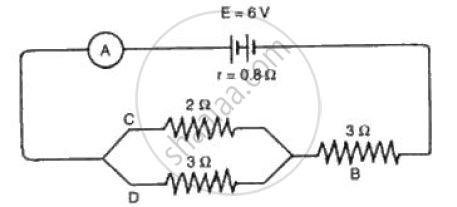
The circuit diagram (Fig.) shows a battery of e.m.f. 6 volts and internal
resistance of 0.8 Ω oonnected in series. Find the
(a) Current reoorded by the ammeter,
(b) P.d. across the terminals of the resistor B,
( c) Current passing through each of the resistors B, C and D, and
( d) P.d. across the terminals of the battery.
What is the purpose of a fuse in an electrical circuit?
An electric bulb is marked '100 W, 250 V'. What information does this convey?
An electric bulb is rated 250 W, 230 V.
- the energy consumed in one hour, and
- the time in which the bulb will consume 1.0 kWh energy when connected to 230 V mains.
An electric bulb is marked 100 W, 250 V. How much current will the bulb draw if connected to a 250 V supply?
What is the SI unit for the current?
Calculate the current in a wire if a charge of 1500 coulomb flows through it in 5 minutes.
Common sources of Direct Current (DC) are:
Common sources of Alternating Current (AC) are:
The RMS value of AC is defined as:
