Advertisements
Advertisements
प्रश्न
State the S.I. unit of electrical resistance and define it.
Advertisements
उत्तर
The S.I. unit of electrical resistance is ohm (Ω). The resistance of a conductor is said to be 1 ohm if 1 ampere current flows through it when the potential difference across its end is 1 volt.
संबंधित प्रश्न
With a neat labelled diagram and derive the equation for three resistances connected in parallel.
The figure given below shows three resistors?
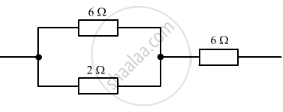
Their combined resistance is:
(a) `1 5/7`Ω
(b) `14` Ω
(c) `6 2/3` Ω
(d) `7 1/2` Ω
Two resistances when connected in parallel give resultant value of 2 ohm; when connected in series the value becomes 9 ohm. Calculate the value of each resistance.
A particular resistance wire has a resistance of 3 ohm per meter. Find the total resistance of three lengths of this wire each 1.5 m long, joined in parallel.
A battery of e.m.f 16 V and internal resistance 2 Ω is connected to two resistors 3Ω and 6Ω connected in parallel. Find:
- the current through the battery.
- p.d. between the terminals of the battery,
- the current in 3 Ω resistors,
- the current in 6 Ω resistor.
An electrical appliance having a resistance of 200 Ω is operated at 200 V. Calculate the energy consumed by the appliance in 5 minutes in kWh.
How does the resistance of a metallic wire depend on the thickness of wire?
What connection is used in domestic appliances and why?
A piece of wire of resistance R is cut into three equal parts. These parts are then connected in parallel. If the equivalent resistance of this parallel combination is R1, what is the value of the ratio R1 : R?
Two resistors having resistance 8 Ω and 12 Ω are connected in parallel. Find their equivalent resistance.
