Advertisements
Advertisements
प्रश्न
In the circuit given below:
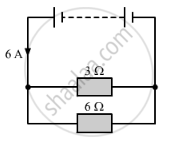
(a) What is the combined resistance?
(b) What is the p.d. across the combined resistor?
(c) What is the p.d. across the 3 Ω resistor?
(d) What is the current in the 3 Ω resistor?
(e) What is the current in the 6 Ω resistor?
Advertisements
उत्तर
(a) The resistors of 6 Ω and 3 Ω are connected in parallel. Therefore, their combined resistance can be calculated as:
1/R = 1/R1 + 1/R2
Here, R1 = 6 Ω ,
R2 = 3 Ω
1/R = (1/6) + (1/3 )
1/R = (1 + 2)/6
R = 6/3
R = 2 Ω
(b) Potential difference, V = IR
The potential difference across the combined resistance,
V = `(6xx2)` V
V = 12 V
(c) The potential difference across the 3 Ω resistor can be calculated as:
V = IR
V =`6xx3`= 18 V
(d) The current across the 3 Ω resistor is:
I = V/R
I = 12/3
I = 4 A
(e) The current across the 6 Ω resistor is:
I = V/R
I = 12/6
I = 2 A
APPEARS IN
संबंधित प्रश्न
Show how would you join three resistors, each of resistance 9 Ω so that the equivalent resistance of the combination is
1) 13.5
2) 6 Ω
State the law of combination of resistances in parallel.
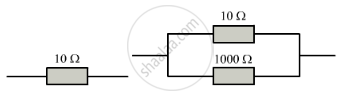
Which of the following arrangement, A or B, has the lower combined resistance?
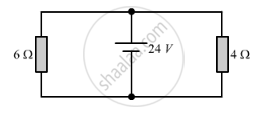
Find the current in each resistor in the circuit shown below:
Are the lights in your house wired in series?
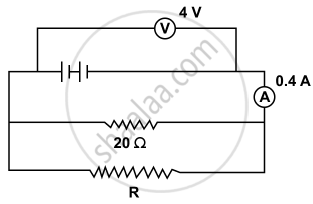
In the following figure calculate:
- the total resistance of the circuit
- the value of R, and
- the current flowing in R.
A battery of e.m.f 16 V and internal resistance 2 Ω is connected to two resistors 3Ω and 6Ω connected in parallel. Find:
- the current through the battery.
- p.d. between the terminals of the battery,
- the current in 3 Ω resistors,
- the current in 6 Ω resistor.
A uniform wire with a resistance of 27 Ω is divided into three equal pieces and then they are joined in parallel. Find the equivalent resistance of the parallel combination.
What are the advantages of a parallel connection?
Explain, why is the p.d. between the terminals of a storage battery less when it is supplying current than when it is on open circuit. A battery of e.m.f. 10 volts and internal resistance 2.5 ohms has two resistances of 50 ohms each connected to it. Calculate the power dissipated in each resistance
(a) When they are in series,
(b) When they are in parallel.
In each case calculate the power dissipated in the battery.
A particular resistance wire has a resistance of 3 ohm per meter. Find the potential difference of the battery which gives a current of 2 A in each of the 1.5 m length when connected in the parallel to the battery (assume that resistance of the battery is negligible).
An electrical appliance has a rating 100 W, 120V. The resistance of element of appliance when in use:
A given wire is stretched to double its length. How will its resistance change?
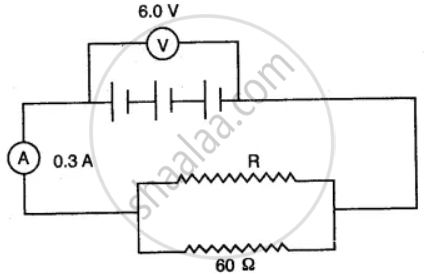
In the figure below, the ammeter A reads 0.3 A. Calculate:
(i) the total resistance of the circuit
(ii) the value of R
(iii) the current flowing through R.
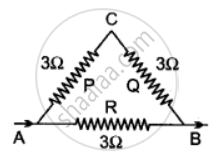
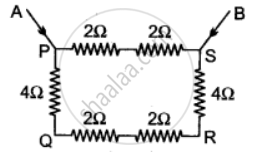
Calculate equivalent resistance in the following cases:
What connection is used in domestic appliances and why?
Assertion: When a battery is short circuited, the terminal voltage is zero.
Reason: In a short circuit, the current is zero.
You are given four ammeters A, B, C and D having the least counts mentioned below:
(I) Ammeter A with least count 0.25 A
(II) Ammeter B with least count 0.5 A
(III) Ammeter C with least count 0.05 A
(IV) Ammeter D with least count 0.1 A
Which of the ammeters would you prefer for doing an experiment to determine the equivalent resistance of two resistances most accurately, when connected in parallel?
Two V-I graphs A and B for series and parallel combinations of two resistors are as shown. Giving reason state which graph shows (a) series, (b) parallel combination of the resistors.

