Advertisements
Advertisements
प्रश्न
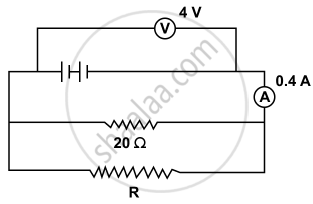
In the following figure calculate:
- the total resistance of the circuit
- the value of R, and
- the current flowing in R.
Advertisements
उत्तर
(a) V = 4 V; I = 0.4 A
Total Resistance R'=?
R' = `"V"/"I" = 4/0.4` = 10 Ω
(b) R1 = 20 Ω; R' = 10 Ω
`1/"R'" = 1/"R" + 1/"R"_1`
`1/10 = 1/"R" + 1/20`
`1/"R" = 1/10 - 1/20`
`1/"R" = (2 - 1)/20`
`1/"R" = 1/20`
R = 20 Ω
(c) R = 20 ohm; V = 4 V
I = `"V"/"R" = 4/20` = 0.2 A
APPEARS IN
संबंधित प्रश्न
How many 176 Ω resistors (in parallel) are required to carry 5 A on a 220 V line?
Show how would you join three resistors, each of resistance 9 Ω so that the equivalent resistance of the combination is
1) 13.5
2) 6 Ω
Explain with diagram what is meant by the "series combination" and "parallel combination" of resistances. In which case the resultant resistance is : (i) less, and (ii) more, than either of the individual resistances?
A resistor of 8 ohms is connected in parallel with another resistor X. The resultant resistance of the combination is 4.8 ohms. What is the value of the resistor X?
If current flows through two lamps arranged:
(a) in series,
(b) in parallel,
and the filament of one lamps breaks, what happens to the other lamp? Explain your answer.
Calculate the equivalent resistance between the points A and B in Fig. if each resistance is 2·0 Ω.

What is the equivalent resistance of 5 equal resistors, each of value 2`Omega` 1 when oonnected in (a) Series ( b) ParaIleI?
Show how would you connect three resistors, each of resistance 6 O so that
the combination has a resistance of(a) 9 Ω (b) 4 .Ω
The equivalent resistance of a parallel combination of two resistors of 30 Ω and 60 Ω is ______________.
Assertion: When a battery is short circuited, the terminal voltage is zero.
Reason: In a short circuit, the current is zero.
