Advertisements
Advertisements
प्रश्न
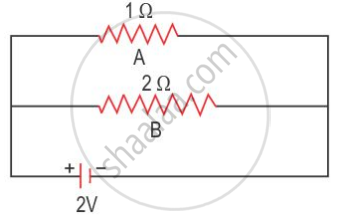
Calculate the current flowing through each of the resistors A and B in the circuit shown in the following figure.
Advertisements
उत्तर
Resulting resistance in parallel
`1/"R" = 1/1 + 1/2`
`= (2 + 1)/2`
`= 3/2`
∴ R = `2/3` Ω
V = 2V
∴ current in circuit I = `"V"/"R"`
I = `2/(2/3)`
= `2/2 xx 3`
= 3 A
Now current through 1 Ω resistor I1 = `"V"/"R"_1`
∴ I1 = `2/1`
= 2 A
Current through 2 Ω resistor I2 = `"V"/"R"_2`
∴ I2 = `2/2`
= 1 A
or I2 = I - I1
= 3 - 2
= 1 A
APPEARS IN
संबंधित प्रश्न
By what other name is the unit joule/coulomb called?
Keeping the resistance constant, the potential difference applied across the ends of a component is halved. By how much does the current change?
A potential difference of 20 volts is applied across the ends of a resistance of 5 ohms. What current will flow in the resistance?
Keeping the potential difference constant, the resistance of a circuit is doubled. By how much does the current change?
Point out two differences between e.m.f. and potential difference as applied to electric circuits.
Two bulbs are marked 100 W, 220 V and 60 W, 110 V. Calculate the ratio of their resistances.
A current of 1 ampere flows in a series circuit containing an electric lamp and a conductor of 5 Ω when connected to a 10 V battery. Calculate the resistance of the electric lamp.
Now if a resistance of 10 Ω is connected in parallel with this series combination, what change (if any) in current flowing through 5 Ω conductor and potential difference across the lamp will take place? Give reason.
How will you conclude that the same potential difference (voltage) exists across three resistors connected in a parallel arrangement to a battery?
Assertion (A): Charges flow from higher potential to lower potential.
Reason (R): Current flows mainly due to the flow of electrons.
What is the measure of the work done on the unit positive charge to bring it to that point against all electrical forces?
