Advertisements
Advertisements
Question
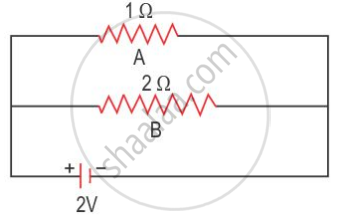
Calculate the current flowing through each of the resistors A and B in the circuit shown in the following figure.
Advertisements
Solution
Resulting resistance in parallel
`1/"R" = 1/1 + 1/2`
`= (2 + 1)/2`
`= 3/2`
∴ R = `2/3` Ω
V = 2V
∴ current in circuit I = `"V"/"R"`
I = `2/(2/3)`
= `2/2 xx 3`
= 3 A
Now current through 1 Ω resistor I1 = `"V"/"R"_1`
∴ I1 = `2/1`
= 2 A
Current through 2 Ω resistor I2 = `"V"/"R"_2`
∴ I2 = `2/2`
= 1 A
or I2 = I - I1
= 3 - 2
= 1 A
APPEARS IN
RELATED QUESTIONS
Which of the following statements correctly defines a volt?
(a) a volt is a joule per ampere.
(b) a volt is a joule per coulomb.
Define the unit of resistance (or Define the unit "ohm").
The potential difference between the terminals of an electric iron is 240 V and the current is 5.0 A. What is the resistance of the electric iron?
A p.d. of 10 V is needed to make a current of 0.02 A flow through a wire. Wire p.d. is needed to make a current of 250 mA flow through the same wire?
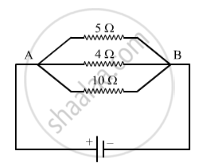
In the circuit diagram given below, the current flowing across 5 ohm resistor is 1 amp. Find the current flowing through the other two resistors.
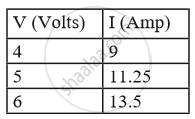
The following table shows current in Amperes and potential difference in Volts.
Which law will the graph prove? Explain the law.
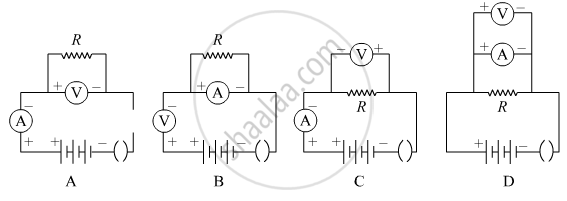
Which one of the following is the correct set-up for studying the dependence of the current on the potential difference across a resistor and why?
A current of 100 mA. flows through a wire. The charge on an electron is 1.6 × 10⁻¹⁹ C. Find the number of electrons passing per second through the cross-section of the conductor.
A 10 m long wire of a particular material is of resistance 5Ω What will be the resistance if the wire is stretched to double its length?
______ is work done per unit charge.
