Advertisements
Advertisements
प्रश्न
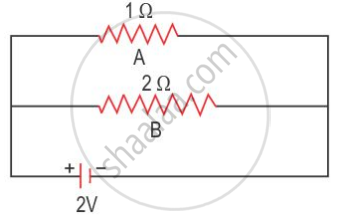
Calculate the current flowing through each of the resistors A and B in the circuit shown in the following figure.
Advertisements
उत्तर
Resulting resistance in parallel
`1/"R" = 1/1 + 1/2`
`= (2 + 1)/2`
`= 3/2`
∴ R = `2/3` Ω
V = 2V
∴ current in circuit I = `"V"/"R"`
I = `2/(2/3)`
= `2/2 xx 3`
= 3 A
Now current through 1 Ω resistor I1 = `"V"/"R"_1`
∴ I1 = `2/1`
= 2 A
Current through 2 Ω resistor I2 = `"V"/"R"_2`
∴ I2 = `2/2`
= 1 A
or I2 = I - I1
= 3 - 2
= 1 A
APPEARS IN
संबंधित प्रश्न
Calculate the work done in moving a charge of 4 coulombs from a point at 220 volts to another point at 230 volts.
The p.d. across a lamp is 12 V. How many joules of electrical energy are changed into heat and light when:
a charge of 5 C passes through it?
b. The values of potential difference V applied across a resistor and the correponding values of current I flowing in the resistor are given below:
| Potential difference, V (in volts) | : | 2.5 | 5.0 | 10.0 | 15.0 | 20.0 | 25.0 |
| Current, I (in amperes) | : | 0.1 | 0.2 | 0.4 | 0.6 | 0.8 | 1.0 |
Plot a graph between V and I, and calculate the resistance of the resistor.
c. Name the law which is illustrated by the above V-I graph.
Explain the statement ‘the potential difference between two points is 1 volt’.
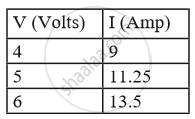
The following table shows current in Amperes and potential difference in Volts.
Which law will the graph prove? Explain the law.
Define the following:
Potential difference
State whether the potential is a scalar or vector?
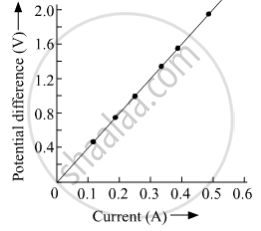
A V-I graph for a nichrome wire is given below. What do you infer from this graph? Draw a labelled circuit diagram to obtain such a graph.
A 10 m long wire of a particular material is of reistance 5Ω What will be the resistance of 5m long wire of same material and the same thickness.
______ is work done per unit charge.
