Advertisements
Advertisements
प्रश्न
Five resistors of different resistances are connected together as shown in the figure. A 12 V battery is connected to the arrangement.
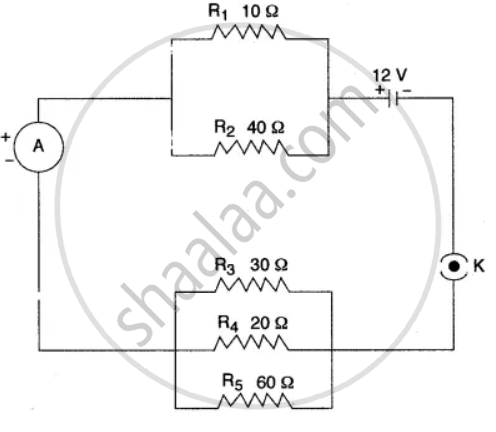
Calculate:
(i) the total resistance in the circuit
(ii) the total current flowing in the circuit.
Advertisements
उत्तर
(i) From given figure, R1 and R2 are parallel.
∵ `1/"R'" = 1/"R"_1 + 1/"R"_2`
`= 1/10 + 1/40 = 5/40 = 1/8`
∴ R' = 8 Ω
R3, R4 and R5 are also parallel,
∴ `1/"R''" = 1/"R"_3 + 1/"R"_4 + 1/"R"_5`
`= 1/30 + 1/20 + 1/60 = 6/60 = 1/10`
∴ R'' = 10 Ω
∴ Total resistance in the circuit
= R' R''
= 8 + 10 = 18 Ω
(ii) V = 12 volt.
∴ Total current flowing in the circuit ]
I = `"V"/"R" = 12/18`
`= 2/3 = 0.667` A.
APPEARS IN
संबंधित प्रश्न
Which of the following statements correctly defines a volt?
(a) a volt is a joule per ampere.
(b) a volt is a joule per coulomb.
Which device is used to measure p.d?
What is the unit of electric charge?
The p.d. across a lamp is 12 V. How many joules of electrical energy are changed into heat and light when:
a charge of 5 C passes through it?
A current of 200 mA flows through a 4 kΩ resistor. What is the p.d. across the resistor?
Define the following:
Potential difference
Point out two differences between e.m.f. and potential difference as applied to electric circuits.
Conceptual question.
A bird sitting on a high power electric line is still safe. How?
How will you conclude that the same potential difference (voltage) exists across three resistors connected in a parallel arrangement to a battery?
