Advertisements
Advertisements
Question
Five resistors of different resistances are connected together as shown in the figure. A 12 V battery is connected to the arrangement.
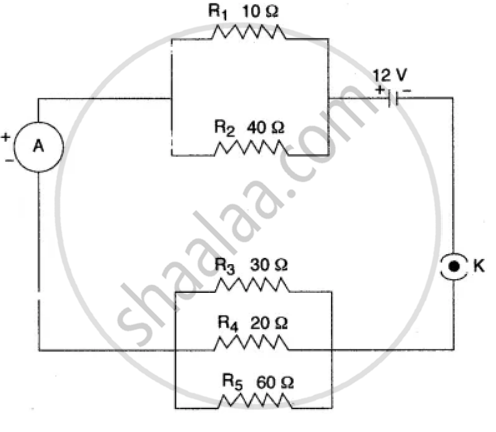
Calculate:
(i) the total resistance in the circuit
(ii) the total current flowing in the circuit.
Advertisements
Solution
(i) From given figure, R1 and R2 are parallel.
∵ `1/"R'" = 1/"R"_1 + 1/"R"_2`
`= 1/10 + 1/40 = 5/40 = 1/8`
∴ R' = 8 Ω
R3, R4 and R5 are also parallel,
∴ `1/"R''" = 1/"R"_3 + 1/"R"_4 + 1/"R"_5`
`= 1/30 + 1/20 + 1/60 = 6/60 = 1/10`
∴ R'' = 10 Ω
∴ Total resistance in the circuit
= R' R''
= 8 + 10 = 18 Ω
(ii) V = 12 volt.
∴ Total current flowing in the circuit ]
I = `"V"/"R" = 12/18`
`= 2/3 = 0.667` A.
APPEARS IN
RELATED QUESTIONS
How much work is done when one coulomb charge moves against a potential difference of 1 volt?
What is the SI unit of potential difference?
How is a voltmeter connected in the circuit to measure the potential difference between two points? Explain with the help of a diagram.
Write down the formula which states the relation between potential difference, current, and resistance.
For the circuit shown in the diagram below:
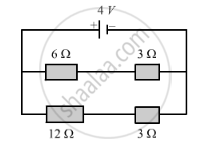
What is the value of:
(i) current through 6 Ω resistor?
(ii) potential difference across 12 Ω resistor?
In the circuit shown below:
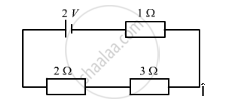
The potential difference across the 3 Ω resistor is:
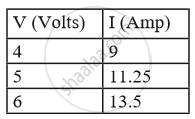
The following table shows current in Amperes and potential difference in Volts.
Which law will the graph prove? Explain the law.
Write proper word from the following group of words in the blank.
(magnetism, 4.5V, 3.0V, gravitational attraction, potential difference, potential, higher, lower, 0V)
Water in the waterfall flows from a higher level to the lower level because of ______.
An electric bulb draws 0.5 A current at 3.0 V. Calculate the resistance of the filament of the bulb.
A boy records that 4000 joules of work are required to transfer 10 coulombs of charge between two points of a resistor of 50 Ω. The current passing through it is:
