Advertisements
Advertisements
प्रश्न
Five resistors of different resistances are connected together as shown in the figure. A 12 V battery is connected to the arrangement.
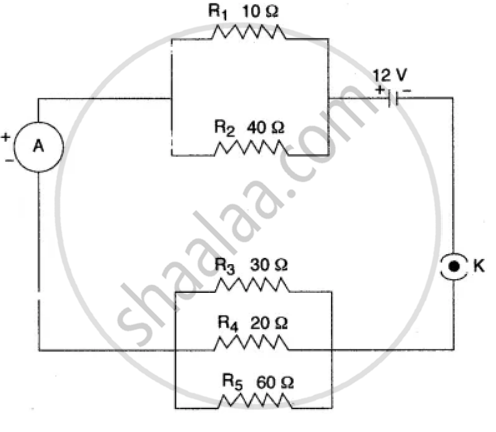
Calculate:
(i) the total resistance in the circuit
(ii) the total current flowing in the circuit.
Advertisements
उत्तर
(i) From given figure, R1 and R2 are parallel.
∵ `1/"R'" = 1/"R"_1 + 1/"R"_2`
`= 1/10 + 1/40 = 5/40 = 1/8`
∴ R' = 8 Ω
R3, R4 and R5 are also parallel,
∴ `1/"R''" = 1/"R"_3 + 1/"R"_4 + 1/"R"_5`
`= 1/30 + 1/20 + 1/60 = 6/60 = 1/10`
∴ R'' = 10 Ω
∴ Total resistance in the circuit
= R' R''
= 8 + 10 = 18 Ω
(ii) V = 12 volt.
∴ Total current flowing in the circuit ]
I = `"V"/"R" = 12/18`
`= 2/3 = 0.667` A.
संबंधित प्रश्न
Calculate the work done in moving a charge of 4 coulombs from a point at 220 volts to another point at 230 volts.
The device used for measuring potential difference is known as:
The unit for measuring potential difference is ______.
Name the law which relates the current in a conductor to the potential difference across its ends.
A current of 200 mA flows through a 4 kΩ resistor. What is the p.d. across the resistor?
Calculate the potential difference between the two terminals of a battery if 100 joules of work is required to transfer 20 coulombs of charge from one terminal of the battery to the other.
Point out two differences between e.m.f. and potential difference as applied to electric circuits.
A 10 m long wire of a particular material is of resistance 5Ω What will be the resistance of 10m long wire of the same material but the double radius.
Define Electric potential.
A negative charge will move from ______ to ______ potential.
